Home

What animal interaction can I expect on an African Safari?

A close encounter with a Buffalo in Africa

Interaction is limited – and should be for your safety. Although, saying that, there are several times when I have felt that I have made a connection with the animals. It’s hard to describe – it’s a sense of staring into each others’ eyes and being comfortable with each other’s presence. I have had this experience a few times with elephants, a lioness and a leopard.

You should always aim for an animal continuing to behave as if you weren’t there when they are in your presence. This is a successful interaction because it demonstrates that  you being there is not disturbing to them. If you see them changing their behaviour at all when you are around, then you should back off/ move on.

Birds and monkeys are the two species that break the ‘no interaction rule’. They’ll pester you no end when you are eating – and if you leave anything outside and unattended they’ll steal it right under your nose. Whilst in South Africa I accidentally left some pencils on the table outside my room and returned to find them eaten by a monkey. Some I recovered with teeth marks embedded, but the HB was a particular favourite of the monkey and that was stolen outright, never to be retuned.

As a rule of thumb we have found that most animals are curious about your presence, but some will ignore you entirely…

When we were on a walking safari in Kruger we were walking downwind from some zebra. They could not figure out what we were and why we were there, so for about 10 minutes they followed us to try and figure it out.

And Giraffes have this lovely habit of failing to notice you at all – no matter how close you are to them. However, once they do see you they’ll stand motionless, staring at you as if to say ‘How did you get there’. They are very comical and seemingly ‘wear’ their ‘thoughts’ on their face.

But none of this is guaranteed – keep an open mind about what you’ll encounter, that way you’ll never cease to be surprised.

Photos from our Kenyan adventure are available in the TarajiBlue Kenya photo gallery.

Photos from our South African safari are available in our Taraji Blue South African photo gallery.

New photos added from the Isle of Lewis


Bosta Beach, Isle of Lewis

We have recently updated our Scottish online photo gallery with images taken in the Isle of Lewis.

Despite being told how stunningly beautiful Lewis is, I did not expect much from the island. I was, however, blown away by the rugged beauty and incredibly wild, pristine coastline. I am not a beach person in the slightest, but my heart melted at the first glimpse of Bosta Beach (see above). I even managed a dip in the sea!

I urge anyone who can to visit this incredible wee island. It’s worth both the time and effort.

Sheep on a Beach


Movement Gallery updated with new photos

Gannets fly over cliff tops whilst onlookers observe

I have continued my endeavour to try a new style of photography which I call ‘movement’. It’s my attempt to capture the essence of movement and disruption – to take myself out of my comfort zone and realise that sharp shots are not always relevant.

New photos have now been added and are available in the TarajiBlue movement gallery.

I have mixed feelings about my results – some I love (like the image of the bee-eater below). Others are very experimental and I am not yet sure how I feel about them – like this shot of flying gannets above and here. What I do like about this style of photography is that it does not rely on a specific place – you can just as easy practise it in your back yard as you can on holiday anywhere. It’s accessible and challenging – and for that reason I am going to continue my focus on this for a few more months. Watch this space!

A southern carmine bee-eater heads off to catch some lunch

Rhino poaching in Kruger National Park…it has to stop.

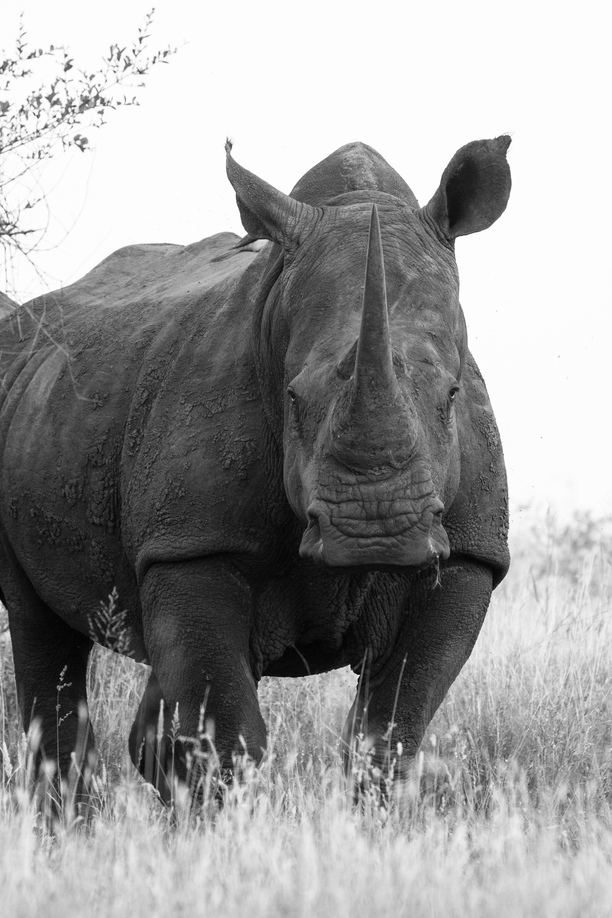
A white rhino in the wild - sadly a rare sight due to poaching

When departing the gates of Kruger National Park we heard the shocking news on the radio that 8 Rhino carcasses had been found in Kruger National Park the day previous. Three were found in the Pretoriuskop area section and the other five were in the Lower Sabie section. All 8 were adults and had been de-horned. This is a growing problem in Kruger. Last year, about 443 rhino were killed for their horns, with 333 killed in 2010. The people who cause this are truly an abomination and need to be stopped

Note, I say those people that cause it, not necessarily those that carry out the dreadful deed (though I have very little patience for them either!). The poachers themselves are desperate people who have been paid circa 200 South African Rand (approx £17) for the Rhino horn. Armed with nothing but an AK47, they own nothing and them and their families live in absolute poverty. They risk, and often lose their lives to obtain the horn for Chinese Medicine (Rhino horn has been used for many centuries in Chinese medicine, where it is ground into a powder and often mixed with hot water to treat a variety of health issues including rheumatism, gout, high fever and even devil possession). They are paid off by western ‘businessmen’ who trade the horn for much, much more than the poultry £17 that cost the poachers are paid. A South African website(fin24) reports that the street value of rhinoceros horns had soared to about $65 000 a kilogram, making it more expensive than gold, platinum and in many cases cocaine. How the heck can the businessmen get away with it?

There has to be a complex and dangerous chain linking the poacher and businessmen, which many speculate involves inside traders in Kruger, the airports and the government – how else would the poachers be able to transport the horn past Kruger boarder and airport checks?

When speaking to a Kruger National Park ranger about this most topical subject, he highlighted that the assumption that all poachers are from neighbouring Mozambique might be flawed – in his experience 60% of the poachers are native South Africans who enter the park and use the tourist sightings and parks’ infrastructure to conceal their intentions and actions. For this reason, rhino sightings are now kept secret by tourists and rangers and for conservation reasons are no longer recorded on the sighting boards in all the SAN Parks rest camps. This is why we’ll also be removing our GPS coordinates from any rhino photos we upload to the Taraji Blue website.

Despite this tragedy, there is a lot of effort being placed into anti poaching patrols in Kruger and they are doing a great job to tackle this issue. In 2011 soldiers and surveillance aircraft were deployed in efforts to slow the carnage and daily and nightly patrols now run across the park.  Local businesses are also getting involved in anti poaching efforts too. For example, A Unitrans Volkswagen and Audi initiative now ensures that every car sold provides a donation of R500 to anti poaching efforts, providing a much needed source of income to assist anti-poaching measures. They have also donated vehicles to the cause.

So why am I telling you about this tonight? Mainly because I am hopping mad about what’s happening and I want to share my grief that these most beautiful beasts are being slaughtered for Chinese Medicine. If raising awareness is one little thing I can do to contribute, then I will do all I can. Please help me spread the word and lets do what we can as a collective to assist anti-poaching efforts.

Images of Rhinos in Kruger National Park are available in our Taraji Blue online photo gallery.

Walk

Walk

I often forget I’ve only been to New York once, back in 2005 on the way back to the UK from a West Coast road trip. This image sums the place up to me – walk, go, go, do it now, forget about the risk. This was taken on film with a Canon EOS 3000, and my latest purchase – a fish eye “lens”.

I admit a was a little naive about photography gear back then and had planned to find a “proper” photography store in NYC and get myself a good quality wide angle lens to snag the scenery with. We ended up in a shop I can’t remember in a street I’d never be able to find again (warning #1!). The store clerk was friendly (warning #2!) and let me try out a couple of options: a wider-angle lens, and an add-on to my kit lens that screwed on and allowed flexibility “without the extra weight”. I tried them both, went outside and had a peer around with them, somehow assessing the optical performance of these things through the viewfinder. Hmm.

Then we got to price. Nothing was tagged (WARNING #3!), but the chap was offering the wide-angle lens around $180, which seemed reasonable but wasn’t as wide as I was really after – I wanted more of a fish eye look. The converter I think came in around $120. That seemed a little high, but then it was doing what I wanted from a lens and it was kind of a wacky look at the time, so why not? I started toward the door to try another dealer, and the guy persisted, persisted, persisted… though didn’t lower his price.

He got me. I paid up, left with this crazy golden thing that turned out (when I got home) to be some shoddy camcorder accessory worth about $30 and I was thoroughly fleeced. Let that be a lesson to me to know your stuff beforehand. Sad, I guess – you just need to know where the better stores like B&H are, otherwise you can get taken for a ride.

Still, I paid for a guy to have a great dinner somewhere!

Plus, even though it was overpriced, it did help me see NYC through a different view and I picked out some shots that just wouldn’t be interesting without the wacky fisheye distortion and the extreme optical fuzziness at the edge of the circle. That’s why mistakes are important – sometimes they aren’t really mistakes.

Spring Has Sprung

A tiny yellow flower emerges from its bud

The onset of spring and the lighter evenings was the perfect excuse to dust off the macro lens and hit the meadows to see what emerging plants and insects we could find. The overcast Bank Holiday weather created a wonderful  bokkeh and cast incredible colours across the Scottish forests and fields, enabling us to capture some beautiful shots of emerging flowers and trees.  Here’s a few of our favourites.Further images are available in our TarajiBlue macro photography gallery.

A flower emerges from a bud on the brand of a tree

A Daisy Awakens

Return of the Mac(ro)

A close up of raindrops on weeds

I think I was one of the few people who was genuinely excited to see the rain this Bank Holiday weekend. Whilst marooned in the middle of a Scottish field, the spring rains provided the perfect opportunity for me to indulge my love of macro photography. I was equipped with my new macro extension rings (a Christmas gift) and was eager to give them a trial run.

I started on the Saturday with the 25mm extension ring on my Canon ES 100mm lens and was astonished at how close I could get to ‘the action’. Hand-holding the camera in the blustery winds proved to be a challenge, but in half an hour or so I’d become accustomed to the equipment and the weather, and had started to produce some good results. I spent most of my time with my bottom pointing skywards, rain dripping down my trousers, as I took to the undergrowth in search of raindrops on grass stems and weeds. I fell in love with what I saw.  The extension rings enabled me to get so close to the plants that three or four raindrops would fill my eyepiece and I’d begin to notice fine hairs on weeds, individual patterns on a single blade of grass and see colours and landscapes reflected in the tiniest of waterdroplets.  The picture above was one of the first I took and it is pretty much straight out of the camera – no editing and crucially no cropping.

I especially like the image below because I love how an ‘ordinary’ weeds has been transformed to look like a Venus fly trap preying on the single and vulnerable raindrop.

I’ll think twice before I weed our garden next time!

Additional macro photographs taken this weekend have been added to the Taraji Blue  macro challenge photo gallery. I hope you like them and I welcome any comments and feedback.

A single raindrop balances on a stem of grass

A review of Shingwedzi, Kruger National Park

An eagle in a tree

We stayed at Shingwedzi for 2 nights in Jan 2012. It was my least favourite of the camps we stayed at. Don’t get me wrong, there is nothing wrong with it, but it just did not shine as much as the other camps did.

It was the second largest camp we stayed in and it seems to have a real mixture of accommodation options. I think we must have been in one the oldest huts in the camp – but were surrounded by what looked like lovely luxurious cottages and newer huts, so maybe we just ran out of luck.

Our unit was extremely basic. Two beds, a bathroom, AC, kettle, a fridge and outside cupboard and braai. There was quite a lot of holes in the walls plugged by toilet paper to try and keep the bugs out. However the beds were comfortable and it was clean…just very worn and dated. I was initially very disappointed when we arrived. I felt it was a step down from Punda Maria..but I gradually realised why I felt like this. There was less of a sense of community. People kept themselves to themselves, unlike in Punda Maria where communal cooking caused everyone to come together and share stories around the braai.

The shop was one of the largest, but not very well stocked. It seemed  to be dominated by curios and clothing opposed to meat, fruit and veg. For that reason we broke with tradition and had a lunch and breakfast in the on site cafe which was ok. We certainly didn’t starve, and did manage to have two excellent braais.

The staff are very helpful, but seemed less warm and welcoming than in the other camps. However, they did personally visit every hut each night to provide an update on the closed swimming pool, and when the neighbours found a puff adder outside their hut they did everything they could to assist.

A downside is that there are no real views from the huts we stayed in. You’re quite ‘land locked and enclosed’ in the camp and you have to venture to the cafe or on site picnic area to see outside the camp.

There are not a lot of routes to drive around the camp – especially if you’ve stayed nearby previously, you might find you are limited for new self drives. Saying that, the short drive to the Bird Hide and Dam is well worth it. The river is packed full of bird life, buffalo and elephants. We spent a very pleasant morning in one spot, watching two eagles fight over a fish and watch a group of monkeys play in the trees. It’s not rich in the big five, but it is a place where you can start to appreciate the less ‘famous’ animals and birds.

If you’ve not stayed locally before your visit to this camp, be sure to head out early, pack a picnic and take a drive out to RedRocks.  it’ll be quite a long day but it’s worth it. You may see giraffe, eland, ground hornsbills, porcupines, elephants, lion, buffalo and various birds.

If you are self-driving and fancy a shorter drive (or a detour en-route to RedRocks), make sure you take the road out of the main gate and when you get to the crossroads (with the bridge to your right), go straight across and take the short 8k drive. Toward the end of the trail you’ll head past a water storage unit on your left by the riverbank and, if you’re lucky, you’ll see elephants on their hind legs drinking from it. Buffalo and warthog are also common here.

For me it’s a camp to use as a transit point from North to South, opposed to one to linger in. But the surrounding area is well worth the visit.

For further information, visit the SANParks website.

Photos from our South African safari are available in our Taraji Blue South African photo gallery.

A review of Punda Maria Rest Camp, Kruger National Park, South Africa

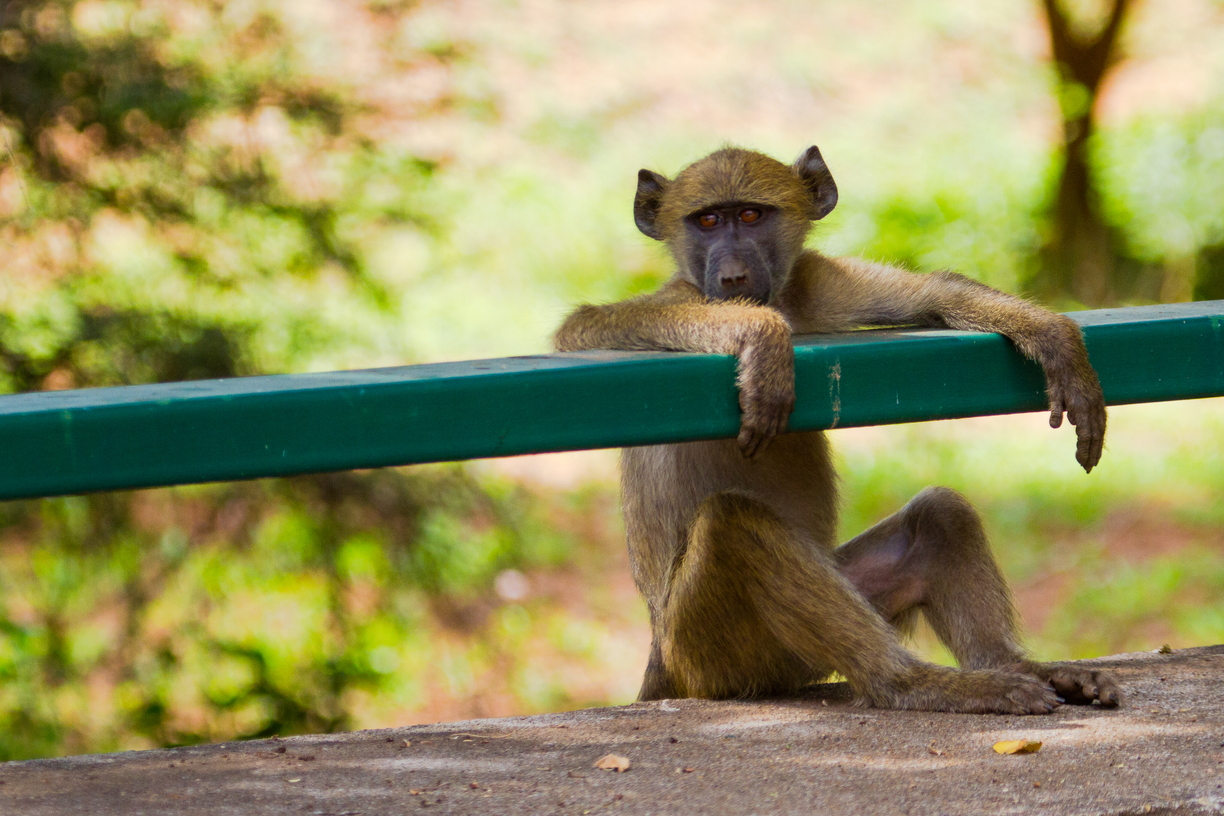
A tired baboon rests against the railings of a bridge in the Parufi/Punda Maria region of Kruger National Park.

This is one of the most friendly camps we stayed at in Kruger National Park and it has a very special place in my heart.

Here’s a brief overview of the camp and the surrounding area. I hope this is useful for anyone planning a safari to Kruger…

We had a bungalow room in a block of 3 others, and had a smallish room with en-suite and full sized fridge/ freezer and kettle. Glasses were also provided. The A/C was second to none (the most powerful of all the places we stayed), and the shower pressure and heat was excellent. Outside our room there was a table and two chairs, perfect for lazy afternoons,sundowners and meals.

Being such a small camp, this was the perfect opportunity for us to meet our neighbours and pick up tips from locals. It is, therefore, a perfect choice of camp for a first timer, self-driving in Kruger. Everyone is so, so friendly, and it was a matter of minutes before we were approached by a local asking where we are from, where we were going and offering invaluable tips as a response. One kind neighbour sat with us and our Kruger map for a whole lunchtime and showed us which roads and routes to take in order to optimise game viewing and our safari experience. His advice was so invaluable that we later altered our accommodation bookings to take on board his recombinations. That’s why I loved Punda Maria  – you have an opportunity to meet people and benefit from their experience.

It’s also an incredible location for birding and the landscape is stunning and unique to Northern Kruger – especially if you take the route to Pafuri (more on this in a subsequent blog post).

It’s located about 6hours 40 mins from Jo’berg and is one of the northern-most camps. For this reason it’s incredibly quiet on the roads and it’s not unusual for you to have sightings to yourself or to fail to see another car on the road the entire journey (bear in mind we travelled in the Christmas and New Year peak season so it will be even less busy in other months).

The shop was also well equipped for the size of the camp, and the camp also has a swimming pool and communal cooking, washing and braai facilities.

If you are new to a braai it’ll show, and you’ll stand out like a sore thumb (as we did). Worry not – locals will take you under their wings and will lend you their coals once finished. They will also give you hints and tips on fire management and cooking and will even share their food with you (aka force feed you tasty treats). Be warned – they are serious about their braais and eat a lot of quality meat! Vegetarians  – stick to the communal hotplates 🙂

Overall I would not hesitate to go back to Punda Maria.  My only words of warning are that a) it’s incredibly hot at 38/39 degrees over Dec and Jan…it will take about 4 days for you to acclimatise to this heat and b) the vegetation is very dense and thus game viewing is harder than in the central or southern regions of Kruger c) It’s also not an area rich in the ‘Big 5’, Though please do not let this put you off – the landscape is worth the trip alone, and whilst we were their there were daily sightings of leopard, buffalo and elephants  around the camp.

For further  information about Punda Maria, see http://www.krugerpark.co.za/Kruger_National_Park_Lodging_&_Camping_Guide-travel/punda-maria-camp.html

Photos from our South African safari (many of which are taken around Punda Maria) are available in our Taraji Blue online photo gallery.

A review of Satara Rest Camp, Kuger National Park, South Africa

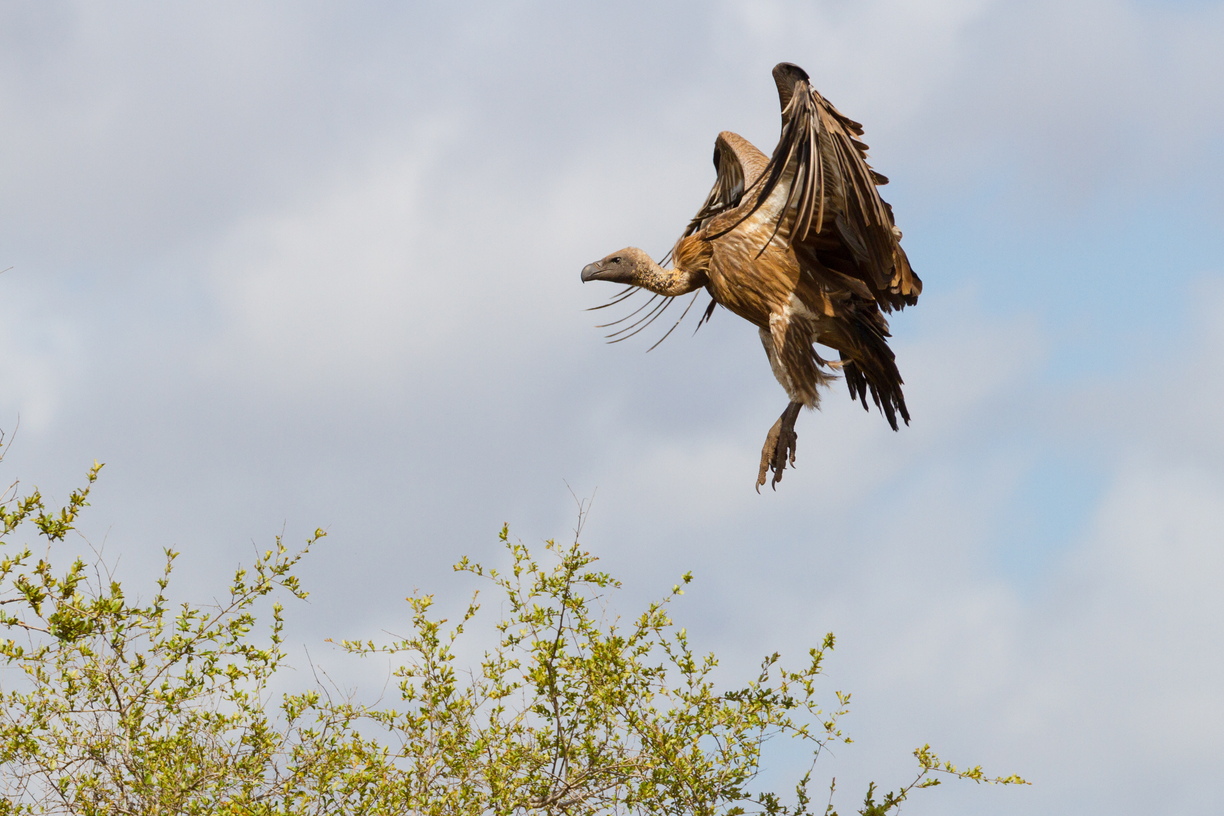
A Cape Vulture chooses a prime position from which to wait for breakfast.

We had the pleasure of staying in Satara Rest Camp for 2 nights in early January, 2012. It wasn’t originally our first choice of camp – in fact, we’d booked originally to stay at Mopani, but after speaking to the locals, they advised us to spend as much time in the game rich central area of Kruger as possible (as we had already spent 4 nights in Northern Kruger). Heeding this advice, we took the decision to switch accommodation less than 24 hours before we were due to arrive at Mopani. The receptionist at Shingwednzi assisted us in this matter and there was no extra cost for the change. It was a decision well made.

Not that we have anything against Mopani. In fact, we stopped off to review the camp en route to Satara and I fell in love with it. It has more of a lodge feel than a camp feel, and the surrounding views over the damn and mopane vegetation was simply breathtaking. There was also a very well stocked shop, an on site nature trail and what looked to be a very comfortable bar overlooking the water. There was lots of outside seating space and a large eating area.  However, we felt that we had exhausted a lot of the drives around Northern Kruger and therefore pressed on toward Satara where there are lots of choices of game drives right on the camp’s doorstep.

Satara is a lovely camp – the largest we stayed in. It was clean, extremely comfortable and modern. It had a well stocked shop (that gets very busy in the last half hour of trading), a refreshing swimming pool and a covered bar and restaurant. All sides of the camp are surrounded with an electrified wire fence to keep the game out – however, this provides great opportunities for game viewing from the comfort of camp. Each day an elephant wandered right by the communal areas, and at evening Hyhena prowled the fence.

Satara also has an outdoor auditorium which screen wildlife and nature documentaries Mon to Sat evenings.

We stayed in a bungalow with a kitchenette and it far exceeded my expectations. The hut was spotlessly clean, as was the kitchen and braai area. Each hut has privacy via wooden screens which surround your private braai area which is equipped with its own outside light for cooking. The kitchenette was well stocked with cutlery, plates, glasses, hotplate, full sized fridge freezer, kettle, toaster etc.

You enter the hut by sliding glass doors to the well sized bedroom (with seperate insect screen), and there is a clean and powerful en suite shower  and toilet. An electronic safe is also provided in the wardrobe. There is also a powerful A/C system (so powerful we had to turn it down) and a ceiling fan.

Outside the bedroom is a covered seating area with a wooden table and chairs and its own outside light. We found Satara to be remarkably bug free – especially compared to the previous camps we had stayed in (Shingwedzi and Punda Maria).It was very pleasent to spend a bug free evening sitting outside after your braai – especially because you could easily spot nocturnal game patrolling the camp fences by torchlight.

It’s a truly fabulous place to stay. For more information, visit the SANParks website.

Photos from our South African safari are available in our Taraji Blue South African photo gallery.