Home

Rock Formations – The New Obsession

Flamborough cliffs

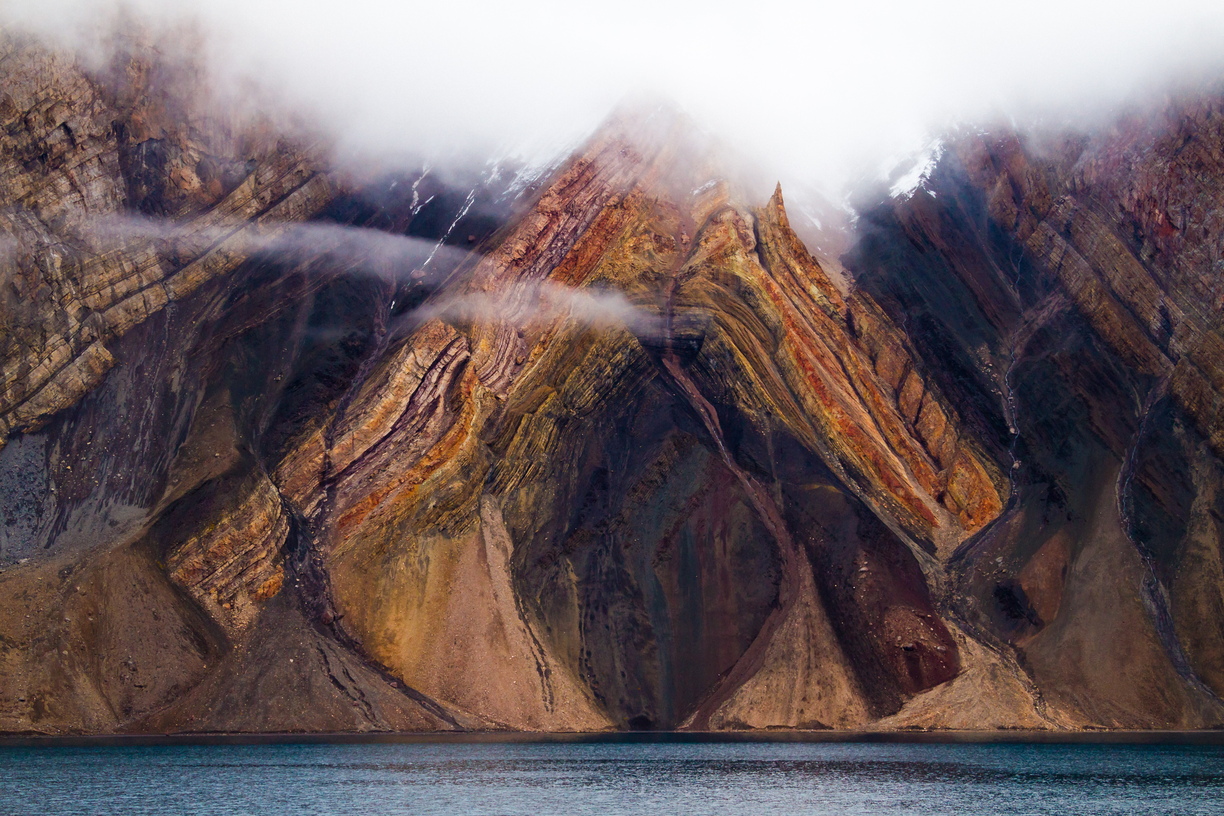
Ever since we saw the incredible rock formations of Greenland’s seascapes (see bottom picture) we’ve become hooked on photographing geology. We’ve found the coastlines of the UK especially fruitful for wierd and wonderful rock formations. I have chosen our top three geology images to share with you today.

The most recent is the shot above – It’s of Flamborough cliffs in East Yorkshire, taken from on-board the Yorkshire Belle on an RSPB cruise. I love the undulations and the way the vegetation hugs the chalk cliffs, but most of all I love the sense of scale…if you look to the bottom of the photo you’ll see a puffin taking off from the water and guillemots on the coastline. We’ve called this “History Repeated”.

Part of a crumpled, warped C shape layer of rock is shown just beneath the top of the cliffs at the Butt of Lewis, Outer Hebrides.

The photo above we call “History C”. It’s part of a crumpled, warped C shape layer of rock located just beneath the top of the cliffs at the Butt of Lewis, Outer Hebrides. We had to climb quite a way down the cliffs to discover and photograph this image.

The image below is what started the whole obsession “History V”. Taken aboard the MS Expedition in Arctic Greenland. It’s an incredible and graphical image highlighting the power of nature and the age of our planet.

The rock formations of Arctic Greenland

Additional photos are available in our TarajiBlue photo gallery.

Trip report. Day 8 in Kgalagadi Transfrontier Park

Barn Owl


The time has come … here’s my account of day 8 in KTP, our last full day in the park.

It was inevitable that the day would be a bit of a write off, having been awake all night. I had become far too obsessed with the sheer amount of barn owls paying us a visit at Killiekrankie in the dead of the night and I had become attuned to hearing that all too familiar ‘chink’ of their claws as they landed on the fence around our cabin’s deck. With each landing I’d wake from my light slumber as if a baby was howling my name, and I’d leap for my camera and throw myself to the end of my bed to try and catch a shot through the huge picture windows of our cabin. With each attempt I’d hear my husband’s muffled laughs from under his bed covers as I got more and more frustrated with my failed attempts. Obsessed could not even begin describe my ambition to capture an image of a barn owl that evening.

Sharing my tales of woe with Jacques (the camp manager) the next morning he promptly smiled and beckoned me over to cabin two – there, bold and brass and in broad daylight were two barn owls sleeping on the water tanks. I didn’t know whether to cry with joy or despair – but either way I relished the moment to be so close to these incredible creatures.

It was all my hubby could do to drag me away from Kieliekrankie that day – and with heavy hearts (but feeling very privileged for our time there) – we checked out, vowing to return as soon as possible…heck, I’ll admit, we even discussed relocating 🙂

We were very aware that this was our last full day in the park and, wanting to make the most of every opportunity, we headed north to the 14th borehole in search of the nesting barn owls. Luck was not on our side, so we returned south towards Twee and en-route we picnicked at the Kamqua picnic site, spending every minute possible spotting wildlife. We were lucky enough to stumble upon some unusual behaviour from a bateleur who was on the Aoub riverbed, wings spread, seemingly heating his belly and underside of this wings in the afternoon sun. Such a comical sight!


A juvenile bataleur demonstrates a strange pose, perhaps soaking up the Kalahari sunshine, perhaps warning off others?

3-4 km north of the Montrose waterhole we stumbled upon the most amazing sighting – we found a family of curious barn owl chicks in a roadside tree! 4 chicks were huddled into a sociable weavers nest, taking it in turns to rotate position and peer into the outside world. One wee chick was particularly enamoured with a secretary bird prowling under their tree, so much so that I worried he might lean over so far that he’d ‘fall out’ of the tree and reveal their nest.


Three barn owls (with a fourth hidden further back in the hole) wander to the edge of their nest in a large hole in a trunk on the Auob riverbed, Kgalagadi Transfrontier Park, South Africa.

That afternoon we saw an array of birds of prey – PCJs, Ospreys, Kites and Eagles appeared roadside from Monro to Houmoed, including a young gabar Goshawk who was determined to ‘strut his stuff’ for the ladies.

A goshawk preys in the undergrowth                                              A young gabar goshawk prowls the edge of the road in the Kgalagadi Transfrontier Park, South Africa.                                                         Lanner Falcon

We arrived at Twee later afternoon and quickly settled in – repacking for our drive to Tankwa Karoo the following day. We were visited by mongoose, huge bees and squirrels before heading over to the restaurant for a lovely meal (springbok pie is recommended) before our evening drive.

Mongoose                                   A ground squirrel eating

We had initially booked on the midnight drive from Twee, but a combination of freezing temperatures and all encompassing tiredness after a week in the desert forced us to an earlier evening drive.. and we were not disappointed. Anna (our guide) was fantastic and treated us to our first ever sighting of the unsociable spring hare as well as sightings of bat eared foxes, cape fox, a wild cat and a large spotted eagle owl.

Rufous morph Spotted Eagle-Owl

We collapsed into bed that evening exhausted from the excitement of the evening, wishing we had just one more night in KTP.

More photos from our trip are available in the Taraji Blue Kalahari photo gallery.

Trip report. Day 7 in Kgalagadi Transfrontier Park

The world as seen through the eye of a springbok

Spurred on by the incredible sightings of recent days and the desire for more big cat sightings we headed out at first light back toward the Auob riverbed and promptly saw a wildcat dash into the long grasses. We hoped this was a sign of things to come, however sightings were minimal and the herds of previous days had moved on. We had to travel a considerable distance to find any springbok or wildebeest. What’s more – the carcass and some organs from the cheetah kill of the previous day was still there and largely untouched from how we’d seen it the night before. It seemed that even the scavengers had moved on.

Undeterred we pressed on and a short while later spotted the silhouette of a cat high on the riverbank. We lost her as quickly as we spotted her but we were determined to ‘hang in there’ and we scoured the horizon for any tell tale signs. We spotted  two eland on the riverbank due north of us, their gazes transfixed on one location on the horizon. They did not move a muscle, simply stared, and stared and stared. We knew they’d spotted something that they were not comfortable with.


http://photo.tarajiblue.com/img/s1/v57/p959015968-2.jpg

Until now my gaze had been fixed on the horizon, but the unmistakable rasp of a springbok as an alarm call caused me to avert my gaze to the dry riverbed and onto a group of bushes which the bok had started to focus on. There, deep in the undergrowth was what I identified as a cheetah, crouched and ready to pounce. She made an attempt (somewhat half hearted) to pounce the bok but gave up as quickly as she started. Her cover broken she brazenly started to stalk across the riverbed – it was then I realised it was a leopard!

To my joy she started to run after a small bok on the ridge but her heart was not in it. All the while she was ‘flanked’ at a distance by a herd of about 20-30 spring bok who were determined not to flee to safety. We followed her progress for about an hour as she sent herds into a combination of mesmerized stares or utter panic, but no matter how close she got they did not run. Seemingly resigned to a breakfastless morning she eventually climbed into a tree and promptly fell asleep in perfect view by the Montrose waterhole. By this time she’d entered into the path of a wildebeest herd, and both them and the bok started to gather at the foot of the tree staring at her.  They stood their ground as a conjoined herd, seemingly un-nerved and not flinching from her presence. One gemsbok even moved to stand  right under the branch she was on, either clueless or seemingly for a closer look …it soon thought better of it. We half expected (hoped!) for the leopard to leap from the tree at any moment, but she barely gave them a second glance as she relaxed on a low slung branch in the shade of the tree, legs and tail swinging happily. Once she’d fallen asleep for a while we realised she’d be there for a while and pressed on, vowing to return later to see if she’d emerge and feel hungry!

Later that day we headed over the dune road toward Kij Kij. It was the first time we travelled this road and we revelled in the stunning scenery. A couple of kms before the Tierkop waterhole I spotted a group of 4 lions – two male, two female sleeping on top of the red sand dune. I was thrilled – I was dying to see lions on the dunes and it was a great photo opportunity as the male lion opened his sleepy eyes and started to yawn and roll over. What’s more – we had the sighting totally to ourselves – no one stopped or came by the entire time we were there. Incredible!

lions lying down However, the lions seemed very susceptible to our car engine – it disturbed them more so than any other animal, so we turned the ignition off and used the handbrake to roll and manoeuvre as required. They quickly became inactive once more in the heat of the day so we pressed on towards Twee.

On our return journey we had a dilemma …do we return to the leopard or lion – or try both? We opted for the leopard, but upon arrival at the tree she had slept in we saw nothing. With the leopard long gone, we decided to try our luck and see if we could make it back to the lions at the Tierkop waterhole. Luck was on our side and we arrived to find the lions waking from their slumber. We were treated to a display of yawns, ‘spooning,’ preening, romantic moments and prowling – all in the glorious golden light before sunset.

A lion prowls toward us, licking his lips

That evening we ‘battled’ with a stunning lizard who’d infiltrated our cabin in an attempt to return him to the outside world. After much coaxing he’d exited, only to return in our kitchen an hour later via a secret entrance. Cheeky!

It was another incredible day in KTP.

More photos from our trip are available in the Taraji Blue Kalahari photo gallery.

Trip report. Day 6 in Kgalagadi Transfrontier Park

Sunset in the Kalahari

We woke early. Wrapped in blankets we headed out onto the deck to watch the sunrise with a coffee to see if any animals would visit the waterhole. It was quiet in camp, so after a beautiful sunrise we jumped into the car and headed out to the Auob riverbed and drove right by a pair of mating leopards. We could hardly believe our luck. We followed them from the dune road to the riverbed and back again as they meandered between the bushes and long grasses, ‘enjoying themselves’ 😉 We were fortunate to spend an hour with them before they slunk off over the horizon.

With hearts pounding and wide smiles we set off to the riverbed once more, stopping dead in our tracks 10 minutes later when we spotted the unmistakable silhouette of two cheetahs high on the riverbank. Cast into shadow by the rising sun, the cheetahs were clearly on the prowl. Feeling lucky we decided there and then to take a gamble and we drove off in the direction the cheetahs were heading to find the closest herd of animals in the hope that the cheetahs would join us for breakfast later. We cracked open the thermos and enjoyed strong coffee and rusks surrounded by a herd of wildebeest and our patience paid off.

Cheetah chases a wildebeest

An hour later we saw two shadows on the top of the riverbank but we barely had time to register their presence before they took off at speed toward the herd, causing utter chaos and panic both inside our car and out. We scrambled for our cameras and threw ourselves towards our open windows to capture the moment. After a few seconds of chaos the cheetah locked onto one wildebeest and started to drive him away from the herd and straight towards us. Heart pounding in my ears, I took my eye away from the lens to see the cheetah running toward us at full speed and we realised she was not going to deter her path. Ali swore, I screamed and the wildebeest roared…the car filled with dust from the chase and for a second we could see nothing – we could only hear the panting of the cheetah by our side as she captured and suffocated the wildebeest right next to us. Absolutely incredible!

 We stayed for an hour or so, but then decided to take a leaf out of the cheetah’s book and we headed back to Kieliekrankie for lunch.

Fancying a daytime braai we lit the fire and set about cooking a nice steak sandwich…..big mistake! We very quickly became surrounded in all directions by sociable weavers who would not be deterred from stealing our toast. Resistance was futile – it was like a scene from Hitchcock’s ‘The Birds’. We packed up and headed indoors to the safety of our kitchen to enjoy our lunch, leaving in our wake a deck full of cheeky, chirping birds. Lesson learned 🙂

Mid-afternoon we headed back down to the riverbed to see the cheetahs once more. Rested and proudly displaying a swollen belly, A Cheetah enjoys a mid afternoon snackboth cheetahs were lounging by the roadside in the golden light, their faces bathed in dried blood. I had never been so close to a cheetah before – they lay right next to our car and you could hear them pant, yawn and lick themselves clean. It was hard to recall them as fearless killing machines when they looked so much like large contented house cats.

Excited by the sighting we quickly lost track of time and dusk was falling…as ever, when we’re running a little short on time, we’ll see a range of fantastic sightings that we don’t have time to stop and appreciate, including a huge eland roadside, bat eared foxes hunting, meercats, mighty eagles and the most jaw dropping sunset.

Eland

That night we settled on the deck with a Cape Red and our first ever Potjie,  listening to the sounds of the African desert and watching our neighbours’ flashlights dance off the dunes in search of lions. Delicious.

More photos from our trip are available in the Taraji Blue Kalahari photo gallery.

Our first Potjie

Close Encounters With Stinky

Marie with Arctic Fox

Allow me to introduce Stinky… he’s an Arctic fox cub who I got to know very well on our trip to Greenland. Allow me to explain…

We’d left the ship for one of our last landings and Ali and I were scouring the landscape, enjoying taking pictures of tiny trees and Ptarmigans. I was out of Ali’s sight when I heard a gasp from above me – two fellow passengers who been relaxing on the rocky hillside above me had an Arctic fox prowling towards them. I looked up and eye-balled the fox. A shiver ran down my spine as he squeezed past the passengers and continued his descent down the hillside. I had little time to react and was petrified that my movements might scare him off so I decided to do away with subtlety and the moment he temporarily averted his gaze from me I threw myself over the nearest bolder to steady my camera.  Here I waited….

My patience paid off, and the fox ambled slowly towards me, never faltering. With my heart pounding in my ears, he came closer and closer, ever inquisitive at my presence. My stone-like stance did not waver as he ran around me, taking every opportunity to interact, even sniffing my back as I lay on the rock. After a few playful minutes he ran off, alerted by the presence of other people, keen to explore further. It was then I sat up and realised why he’d been so inquisitive …I had inadvertently thrown myself into a pile of wet and fresh fox dung. No wonder I was so appealing!

Alistair with Arctic Fox

Additional images from our adventures in the Arctic are available in our Taraji Blue Arctic Photo Gallery.

Trip report. Day 5 in Kgalagadi Transfrontier Park

Kieliekrankie Wilderness Camp

This morning we headed off to Kieliekrankie Wilderness Camp. We had been looking forward to this so much and, therefore, after stocking up on a few essentials at Mata Mata, we headed into the dunes with huge smiles on our faces.

En-route we saw a herd of 17 giraffe, bat eared foxes, gemsbok, wildebeest and springbok, not to mention an array of beautiful birds of prey.

Of course it would have been rude not to stop off at borehole no.14 on the way to see if any of the barn owls were home, so I declared a breakfast stop and we feasted on bacon and chutney sandwiches outside the nest. This time we were a little bit lucky – someone was definitely home. Every now and then we’d catch a glimpse of a wing as the owl stretched and preened, and we’d capture the occasional stolen glimpse of a beady little eye checking us out. It was more than enough to satisfy my owl-lust, so after an hour we pressed on southwards on the main road towards Twee Rivieren.

Grasshopper at Kieliekrankie Wilderness Camp

We arrived at Kieliekrankie Wilderness Camp mid afternoon and could not wait to explore our accommodation. I barely got through the front door – thrilled by the lizards, grasshoppers and odd looking bugs gracing our doorstep. I grabbed my macro lens and set to work immediately. Braai at Kieliekrankie Wilderness Camp

Kieliekrankie is a wilderness camp of just 4 cabins perched atop the red dunes of the Kalahari. The wooden cabins are sensitively positioned to offer maximum privacy. We were in cabin 4 right at the edge of the camp and had a wonderful uninterrupted visa. Upon arrival we were informed that there were 4 lions resting on the dune opposite – the night previous they’d been at their most curious and had spent the evening trying to get into the bathroom of cabin three – tearing at the cabin’s canvas sides with their teeth. This was more than enough of a warning for me to stay well clear, so I parked myself firmly on the deck with a pair of binoculars not wishing to venture any closer.
We decided to spend the afternoon in camp to see if the lions would venture any closer. Deciding on an early braai we lit the logs, grabbed a beer and settled on the deck all eyes fixed on the dunes and the waterhole. It ended up being quite a quiet night in camp – but the highlight by far was when a beautiful barn owl landed right next to us on our deck after dinner and regarded us with such curiosity – we daren’t breathe or move and an obsession was born that very moment – for me to catch a barn owl on camera.

More photos from our trip are available in the Taraji Blue Kalahari photo gallery.

What to expect from a self drive safari and how to prepare

An elephant

…Long days in a sweat-box (car), adrenaline fuelled and anti- malarial induced mid-day dreams and the ability to hold your bladder for hours on end….if you think you’re up to it, read on!  🙂

A self drive is what you make of it. It can be as slow paced and relaxing or as hard-core as you like. That’s the beauty of it. Some people opt for it because they don’t like the idea of being awoken at 4am every morning when paying £250pp a night in a luxury lodge, others do it for the control it provides them with or for the money it saves them. Whatever your reason, you are in for a treat. One thing is for sure – you get out what you put in, so we opted for the hard-core experience and reaped the rewards.

In summary, when braving the african bush alone you have three main options:

a) Follow your nose and see where the road takes you…stopping to ask passing vehicles what they have seen and where

b) Plan ahead and ask the locals what roads offer the best sightings, but remain flexible to see where the mood takes you

c) Conveniently time your departure with the morning and afternoon lodge / camp game drives and follow their vehicles around.

We opted for option a) but quickly switched to b) on our first night after speaking to the incredibly friendly locals, but I cannot deny that we were not tempted by option c) on slower days when the game was seemingly spotting us at a distance and retreating.   My advice is take the opportunity to join a communal braai at your camp and learn from those who have been safari-ing for years. They are more knowledgeable and sensible than you, as a newbie, will ever be. They will prevent you wasting time on roads with thick vegetation and no vantage points, and they can point you in the direction of how to beat the crowds and where to spot the more elusive animals. Of course nothing is guaranteed, but this advice is free and well worth heeding.

When setting off on your safari, drive pack more food and drink than you think you’ll need. It only takes one or two unexpected wildlife encounters and you can be out for three times longer than anticipated in the blistering sun and humidity. We found it useful to ensure that we always had a cool bag stacked with cooled water, fizzy juice, sandwiches, fruit and crisps  / sweets.  This ensured we had the kind of food and drink that you could ‘dip in and out’ of without the commitment of having to stop and cook or ‘formally’ picnic. We often had breakfast and lunch in our car by the side of a herd of ellies or a pride of lions….unadultered luxury. We also bought a Thermos cup to allow us to drink green tea / coffee on the move in the early mornings. This approach required us to plan ahead, often cooking the bacon for our morning sarnies the night before and ensuring that we were back at camp in plenty time to shop for the next day before the shops closed for the night. We’d also need to wake earlier to boil the kettle, make the bacon sarnies and compile the cool bag. The fairest apporach was for us both to wake at the same time, and whilst one person was in the shower the other would prepare for the day ahead (we’d take it in turns).

When out and about there are several picnic sites across Kruger. If you are with children, or have a weak bladder, you might want to plan your route accordingly. Some sites are (much) nicer than others so it pays to ask ahead. Some of the sites are in incredibly beautiful  locations, with look-out points. All offer BBQ facilities and toilets (ranging from long-drops to sparkling, flushing facilities). They also sell cold drinks. Many of the SANParks camps also have day-visitor facilities ranging from dedicated picnic points, facilities, canteens and shops. Some camps are more flexible then others.  The rule of thumb which I would suggest is that, unless you can be completely independent (i.e no children or health issues), fail to plan and plan to fail.

If hiring a car, consider a hatchback – that way you never have to leave the car to enter your boot (you are only allowed to leave your car at precious few designated points in Kruger). Having a back-seat also allows you to have the freedom to dash from side to side of the car depending on the wildlife. It also ensures you have plenty space in your car to store food and drink without it impinging on your freedom to move around in the car. Footwells, under the seat storage and seat-back pockets are incredibly useful for storing sweets, lens caps, memory cards, spare shoes, refreshing wipes etc.

Be prepared to get COVERED in dust. You’ll spend the entire holiday in a car with the windows down and you’ll get blasted with sand. Ladies, it is a a great exfoliator, but it is not at all glamorous. Therefore, don’t wear your D&G, instead wear sensible clothes which you don’t value and can wipe your brow on several times a minute, and be preprepared to get filthy! To this extent, be prepared for how much the climate can change as you travel from North to South or vice versa. It’s much hotter up north!

Have a decent wildlife guide and a pair of binoculars permanently  in the car – preferably one each. You’ll spend your entire time trying to identify what, where and why – this is all part of the experience, and you’ll enjoy it more by identifying and understanding the wildlife you spot.

Finally – don’t be too seduced by the need to see the big five. It’s easy for me to say, having seen them several times over – but the experiences we find most enriching are with the birds and mammals we never expected to see, e.g painted wild dogs, jackals, spotted hyenas, night-jars, owls, honey badgers, ground hornbills, giraffes, zebra, hares, kingfishers, birds of prey and monitor lizards. These are the kinds of animals which people will drive past in search of the big five, leaving you free to spend a lot of time alone with these amazing creatures, providing interactions you never thought possible.

If you fancy it – give it a go! A self drive safari is one of the most rewarding experiences we’ve done.  Above all – enjoy every moment and take nothing for granted.

Images from our South African self drive safari are available in our online Taraji Blue South African  gallery. 

Trip Report. Day 4 in Kgalagadi Transfrontier Park

Up close with a springbok

The next day we were booked into the honeymoon tent at Kalahari Tented Camp (as a treat for our 10th wedding anniversary)  so we packed the car at first light, grabbed our coffee and rusks and headed south to explore the surrounding area.

I’d been informed by the forumites that there was an old sociable weavers nest by the 14th borehole in which barn owls nested. I was unbelievably inpatient to get there and, was it not for my husband driving, I’d have headed straight there and ‘camped’ out all day.

As it was we had a very enjoyable morning meandering around the loops past the nearby waterholes, enjoying lots of close encounters with fearless springbok, eagles and gemsbok. We also tried a bit of tracking – scouring the sandy roads for cat prints – and struck lucky with a set of what we believed to be fresh leopard prints and scat on the approach to the 13th borehole. We waited around for an hour or two in the vicinity to see if there was any evidence that the leopard was still around. She wasn’t – at least not in a location we could see her.

We pressed onwards towards the 14th borehole with high hopes for our very first barn owl sighting…

The nest is actually on the left of the main road (as you are heading north to Mata Mata) at the southern junction to the loop road on which the 14th borehole is located. It’s very large and easy to spot once you know where to look but might be difficult to spot in the summer due to the overhanging branches. We pulled up, switched off the car engine and waited in silence, cameras and binoculars at the ready. The entrance to the nest was covered in fresh droppings so we knew someone was home or had visited recently. For now it would be a waiting game.

And wait we did…for hours. But to no avail. There was no sign of any activity or resident. Time pressed on and we reluctantly decided to head back north for lunch.

A few km’s on and we heard the most ear piercing and terrified scream – of which animal we had no idea. We slammed the brakes on and grabbed our binoculars – Ali took to the right hand side of the car – me the left. It was then we noticed three jackals on the hillside, but they could not account for the terrifying noise that ensued. We scanned the horizon looking for something else – something else was happening and we’d not yet pieced together the jigsaw.

Suddenly it all fell into place – on the hillside two adult bat eared foxes  paced nervously, stopping to fix their gaze into the bushes behind the jackals every 30 seconds or so. The bushes were the source of the screams – a juvenile bat eared fox had been captured by the jackals and was being eaten alive. My eyes filled with tears as we watched – not because of the horrid scene unfolding before us (this is, after all, the circle of life), but because of the constant screaming of the baby fox and the relentlessness of its parents to give up the flight to retrieve it. The fox was brave to the very end and fought off the jackal family as long as its strength would allow it. As quickly as it had started it ended, and the ear piercing silence fell upon the bush once more – this is when we and the bat eared fox parents knew the end had come. The cub was dead and its suffering ended. As the parents turned to slowly walk away we also started our engine and left the cub in peace.

This whole episode threw me into turmoil – I thought jackals were scavengers. It never dawned on me  that they are also fearless hunters.  To think, I had entertained one around our braai in Nossob just nights before, as if it was a house dog. This is why I love Africa so much – it challenges your preconceptions and constantly forces you to reconsider your expectations about the natural world.

Bat eared fox

With hearts heavy and adrenaline pumping we set off back to camp to check in once more. However, a few kms on we spotted a few cars gathered by the roadside. Upon arrival they pointed out to us a cheetah feasting on a carcass in the distance.  They’d not witnessed the kill – but judging by the state of the carcass it was more than a few hours old. We stayed for a while but decided to press on…familiar with cheetah’s eating habits we knew she wouldn’t be going anywhere soon given how much meat was on the carcass and the heat of the afternoon sun. We therefore took a note of her location on our map and set the car’s trip-o-meter, vowing to return to her as late as possible in the afternoon when she might become active once more.

Return we did – about 4pm that afternoon. She was still there, sleeping by the, now stripped, carcass. Being only car present, we turned off our engine and waited. 40 minutes later we witnessed her sleepy eyes open and we sprung into action…cameras set up we waited and waited in the hope that she might walk towards us.

Someone up there was looking down on us with good fortune that day because she stretched and turned straight towards us. After a few tense minutes (will she / won’t she?!)  she started to walk across the riverbed straight towards us. By now the golden hour was upon us and the landscape was cast in the most incredible gold hue. I heard myself whispering out-loud, willing the cheetah to step out of the occasional shadows into the incredible late afternoon light. Time and time again she obeyed. It was an incredible sighting – the light danced off the fine fur around her head and body, creating an almost angelic glow around her. She paused every now and again, but her progress towards us was otherwise steady and constant. Undeterred by our presence (and because no other cars arrived in the interim) she did not think twice about walking right up to, and by our car. You could see the dried blood around her face, contrasting against the glistening whilst teeth she bared every now and then. It was a rare and amazing encounter with a beautiful animal. One which I will remember for a lifetime.

Close up of a cheetah

That night sleep was impossible – the combination of the freezing cold and the adrenaline pumping from the day’s sightings meant we had a very broken sleep. However, a warm bath in the honeymoon tent (whilst wearing a wooly hat!) helped to calm me somewhat.

What a day!

More photos from our trip are available in the Taraji Blue Kalahari photo gallery.

Trip report. Day 3 in Kgalagadi Transfrontier Park

Cheetah with cubs

We headed out at first light fuelled by caffeine and rusks and headed out Nossob’s Northern Gate. Opposed to scouring the plains we decided to choose a spot by the riverbed and wait to see if anything would emerge. Our patience was rewarded with a distant sighting of a mother cheetah and 4 furry cubs. The cubs were independent and curious, frequently venturing away from their mother’s watchful eye to climb a dead tree branch or  play fight with one another. They were the quintessential cubs – very fluffy, very playful and a handful for their mother. We tracked them until they disappeared out of view and into the long grasses of the riverbed.

Over lunch we decided to change our plans and head over to Kalahari Tented Camp a night early, so we packed up the car and off we went. It was a beautiful drive and we were treated to stunning landscapes – rolling dunes and hilltop vistas.

The closer we got to camp the more the landscape opened, treating us to wide vistas with  sightings of giraffes ambling across the Auob riverbed, bat eared foxes hunting for insects and from hilltop vantage points in the late afternoon sun we spotted another cheetah mother with 3 cubs on the hills opposite.

Upon arriving at Kalahari Tented Camp at 6pm we set about unpacking and lighting the braai – scouring the riverbed at sunset for hyena (contrary to expectation none emerged during our entire stay). We popped on our thermals (it was -10 degrees) lit a fantastic braai and treated ourselves to the most incredibly tasty meal of boerewors and bbq’d butternut squash with garlic, spices and creamed sweet corn all washed down with cape red  (recipe courtesy of fellow forumites). We loved it so much we had exactly the same meal again the following night. After dinner we settled into our (freezing cold) tent, both of us snuggling into the single bed by the window overlooking the riverbed with a hot chocolate and Amarula (again, thanks forumites!!) and fell contently to sleep.

More photos from our trip are available in the Taraji Blue Kalahari photo gallery.

Kalahari Tented Camp

Trip report. Day 2 in Kgalagadi Transfrontier Park

ScOpsOwl

We jumped out of bed way before the alarm went off, awoken by the smell of braais and excited by the promise of our first full day in the Kalahari. I quickly showered, brewed some strong black coffee, made some bacon sarnies for lunch and loaded the car with our camera gear, all the while unable to take my eyes off the perimeter fence, hoping to capture a glimpse of something.

Thermals on and fleeces zipped up, we headed out Nossob’s northern gate at first light eager to find big cats and birds of prey.  We headed about 25 km to a picnic spot and, in the company of  gemsbok, delved into our first ever bag of rusks. We felt instantly at home. In the distance we heard the unmistakable roar of a lion – we waited around to see if they would materialise but their roars became increasingly more distant.

Despite all the advice from forumites and all the pre-reading I conducted prior to the trip, I was still a little shocked at how hard it was to spot wildlife and how rare sightings were. Being used to Kenya and Kruger, I had set my expectations a little too high and on the first morning we’d seen little more than an eagle, springbok and jackal. This didn’t bother me too much though, because I quickly became happy with occasional sightings of tree climbing mice, ground squirrels, meerkats, mongoose, rollers and bee eaters.

After a busy morning driving’ around North Nossob we retired for lunch. I’d retreated into the kitchen to start preparing the food and was about to head out to the braai when I saw my husband frantically arm waving, asking me not to leave the building. I was very confused. We attempted to lip read and I, somehow, interpreted that a porcupine was outside the door… I lay flat on the floor and inched open the door, peering tentatively around it. There, on the patio, was a tiny scops owl. I’d been looking for them ever since we’d arrived and here he was, quite literally on my doorstep. We looked at each other eye to eye, neither one quite understanding nor expecting to see the other. I daren’t breathe or move, I was close enough to almost touch him. It was an incredible encounter.

That afternoon we headed out of Nossob’s Southern gate to explore the nearby loops and waterholes. We were treated to sighting of gangly legged secretary birds hunting, colourful bee eaters frollicking on branches by the roadside and herds of springbok and ostrich. To our delight the roads had also been repaired, so the bone shaking was kept to a minimum which provided for a much better safari experience.

That evening we retired to the hide at Nossob with an Amarula to watch jackals and gemsbok at the waterhole.

More photos from our trip are available in the Taraji Blue Kalahari photo gallery.

Gemsbok fight