
Home

The evolution of our trip to China

Photo & Video Sharing by SmugMug

I had always dreamt of visiting. I recall, when we bought our first house I was so in awe of Chinese culture that I couldn’t wait to use Chinese fabrics, art, decoration and faux Chinese objects throughout the house, dreaming of they day I’d have a chance to experience this culture first hand.But then our love our of wildlife photography took over, and wildlife became the main focus of our holidays, taking us to destinations like Ecuador, Galapagos,  Kenya and Antarctica.Ali had never fancied China – he wasn’t repulsed or put off by it, he just was not as driven to visit as I was and he saw value in visiting many other destinations on our do list first, as did I.Then one late autumn evening we found ourselves armed with travel brochures, searching for a cheap Christmas holiday destination. We excitedly booked a 2 week trip to China with a popular group tour operator, only to wake the next morning and instantly regret our decision. We’d made a rash decision based on cost alone, and realised we really did not want to spend two weeks touring one of the world’s most intriguing destinations with a bunch of young and eager students – we were too old for that and worked far too hard to earn our leave to share it with people. After a frank and honest call on our way to work, and less than 6 hours after making the booking, we’d decided to cancel and go it alone in China – no students, no backpackers, no tour operators. We’d decided to travel alone, doing what we wanted, when we wanted. I ran home that evening eager to research the vast country and compile a trip of a lifetime.

It took weeks to plan and research. We purchased a ginormous white board especially for the occasion and spent every night annotating a hand drawn map of China, plotting routes, calculating costs and prioritising activities we wanted to do and places we wanted to go. This has since become a staple of all holiday planning.

We were convinced we’d made the right decision – even after forfeiting our deposit on the previous trip. The more we researched the country and devoured books and maps, we became more inspired about the opportunities we’d have to take a path relatively untraveled and tailor the holiday to meet our needs, desires and interests. We were daunted – I will not deny that! We were visiting a huge and complex country, travelling to places with incredible poverty and power in equal measure. We pencilled in destinations where no one spoke English, when no signage would be in English, places where British tourists rarely visit. To help prepare for the trip we started to learn basic mandarin – hoping to pick up enough of the language to ask for drinks, discern between meat, fish and veg,  offer basic greetings and adhere to their cultural norms.

It might sound like an obvious thing to say – but China is HUGE! We’d decided to set ourselves an ambitious itinerary for the three weeks we had. We wanted to take in a mixture of key cities, countryside, local cultures and wildlife. In the end we decided on the following itinerary:

International flights from London Heathrow to Beijing
Beijing for 5 nights
Overnight train from Beijing to Xian
Xian for three nights
Overnight train from Xian to Chengdu
Five nights in Chengdu – including one road trip to spend a night on Emei Shan
A flight from Chengdu to Harbin for the ice festival
Four nights in Harbin
A flight from Harbin to Hong King (via Shanghai)
Three nights in Hong Kong
International flights to London Heathrow

All accommodation, rail and air travel was booked over the internet and tickets delivered to Chinese address where we’d be lodging. There was a certain amount of organisation required to ensure that you could confirm your Chinese accommodation address at the time of booking air and rail tickets, and we were required to reconfirm bookings at several times during our trip -but we found our local hosts and hostesses were all too happy to hold our tickets in anticipation of our arrival and assist us with and confirmations required mid trip.

It’s worth highlighting that this entire trip did not cost much more than the cheaper trip we’d originally with Intrepid travel – proving that a bargain might not always be as it seems, and that it really is worth tailoring your holiday yourself. For this additional spend, we got to spend a week longer in China, stay in the upgraded accommodation we wanted, and visit more far flung places of the country.

The moral of the story – follow your heart!

Our China trip log will continue within this blog.

Photos and further information about our trip are also available in our photobook of China.

Interview with Alistair Knock, co-founder of TarajiBlue

Ali in Iceland

Each issue of the Wanderlust travel magazine showcases three people who answer questions about their travel plans, their preferences and their experiences. I thought it’d be good fun to do this with Ali (my hubby) and document his responses in this blog.

Mountain / Jungle / Desert – which are you?
My heart says jungle, but it’s actually mountain because I like the challenge of climbing and finding new perspectives. My favourite is Blomsterbukten in Greenland… whilst wandering the hills alone I stumbled into a pair of Arctic Hares and had the whole experience to myself. I had a lovely view over the bright pink lake and out towards the sea.


What was your first greatest travel experience?
Waking in the night at Hippo Hollow (in South Africa whilst on honeymoon) to find hippos right outside our balcony. We were fairly new to safaris and had not expected these types of encounters at all. It was unexpected and a pleasure to have that kind of proximity to wild animals.

What has been your favourite journey?
Antarctica! Because it truly was a journey – it took a long time to get there and we had a rollercoaster of emotions along the way when flights were delayed and we wondered if we would get there in time. The experience of a three day Drake Passage crossing made it feel even further away.

Which are your top five places worldwide?
Kenya – because of the abundance and diversity of wildlife, the smell you get when you step ff the plane and the happiness and friendliness of the people

Greenland – because of the sheer scale of the place, the outrageous landscapes and the comforting solitude

Antarctica – because of the penguins!

Hong Kong – because it feels strangely like home.

Scotland – because it is a reliable friend.

Which passport stamp are you most proud of?
Russia. Because both times we visited I tried hard to learn the language and alphabet and for once it paid off. I am proud to have tried to understand the place before we visited.

What passport stamp would you most like to have?
Ethiopia. Because it is still under-travelled, and I think we have a connection with it from growing up (recalling the famines and fund raising from school ages) – it’d be nice to see the places decades on.

Where or what is your guilty travel pleasure?
Camera lenses 🙂

Which place would you not go back too?
The Ishtar Kempinski Hotel at the Dead Sea in Jordan because it is such a polar opposite to the rest of Jordan – too opulent, too over-facing, not genuine enough and not all that friendly (compared to the rest of Jordan).

Any travel regrets?
I don’t think I have any. I don’t ‘do’ regrets – to have any travel ones would be silly!

Kit Bag Contents

A bland photo of too much plastic and metal

I know this is a terribly dull topic for many, so my excuse is that this is a list for my own future reference when preparing for a trip. We have two smallish backpacks to cram all this into (Lowepro Flipside 400 AW and a Lowepro Mini Trekker Classic*)

Bag 1:

  • 7D
  • Some random super telephoto lens rented from the excellent Lenses For Hire (UK)
  • 20 Gb CF memory cards
  • Super wide-angle lens
  • Macro lens
  • Mini laptop
  • Jobo or other smallish external hard drive as a backup to the main drive
  • Microfibre cloths
  • Fluid video head, which annoyingly doubles the weight of the tripod
  • Tripod precariously and lawsuit-ily hanging from the front or side of bag
  • USB cables
  • Lens hoods all over the place
  • Rode video microphone which could do with redesigning for SLRs before it permanently scars my forehead
  • Dead cat for the mike
  • Kindle! J’adore

Bag 2:

  • 40D – primary SLR (needs to step up to the mark and metamorphise into a 7 or 5D really)
  • 30D – backup SLR and time lapse fanboy
  • 100-400mm lens (tends to be lighter than the rental!)
  • 20 Gb CF memory cards
  • backup wideangle lens
  • 50mm f/1.8 that never gets used but just comes along for the ride
  • External hard drive
  • Binoculars
  • Gorillapod with pan/tilt head
  • Camcorder
  • Waterproof compact camera
  • USB cables
  • Plastic bag (raincover)
  • Occasionally, PSP and Nintendo DS

In the hold:

  • MULTITOOL. CRITICAL.
  • Set of portable Allen keys, because Manfrotto decided to use different sizes everywhere.
  • Chargers, fewer than I’d expect thanks to some rationalisation and third-party suppliers

(* short reviews: Trekker fits tons in, the two front pockets expand to fit loads more, but is old and doesn’t have good padding in the shoulders, i.e. isn’t being used correctly and so can be very uncomfortable. The Flipside is very comfortable even with heavy loads, but doesn’t fit much in the front pocket – my 11″ laptop just fits – and can be hard to pack as a result of the rear-access panel flexing back against the bag.)

A review of Casa Marbella, Tortuguero

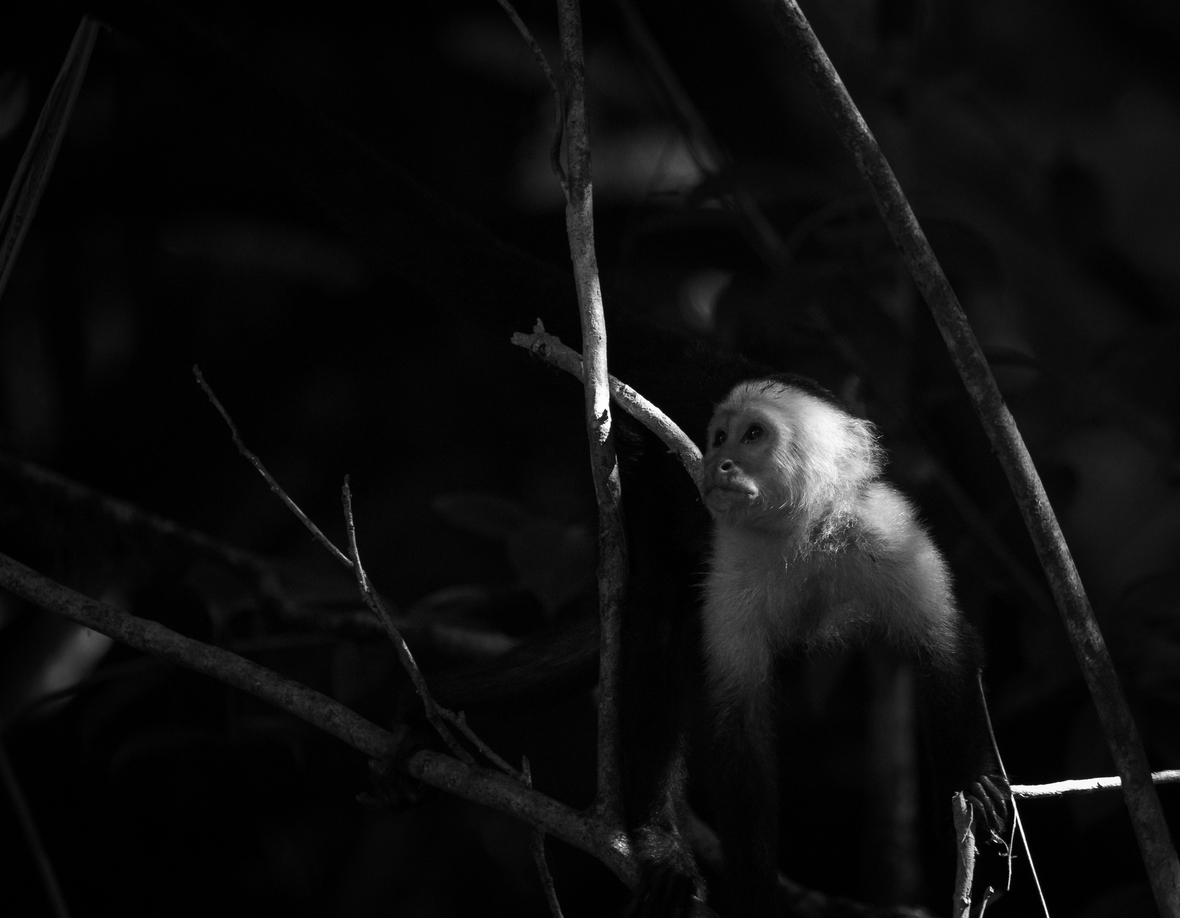
A capuchin pauses for thought

We had the privilege of staying at Casa Marbella, Tortuguero on our adventure in Costa Rica. Lets face it, when you’ve travelled the road (much!) less travelled to get to Tortuguero independently, you are hoping desperately that the accommodation lives up to its reputation. I need not have worried. I was not disappointed.

The reviews of Casa Marbella had built it up so much that I had spent the weeks before the holiday trying to manage my own expectations downwards. Not easy! But it was everything I expected and more.

It’s a homely and comfortable B&B. There’s no frills, spas or room service, but that’s not why people stay in Tortuguero village – you instead choose a place that has amazingly comfortable beds, is very clean, has powerful cold showers, and a decking from which you can watch the wildlife and locals sail by. You choose your B&B for the friendly welcome you’ll receive, the scrummy breakfasts eaten outdoors and privileged access to incredible guides like Daryll and Roberto. Not to mention the added extras like that fact that they have a kayak that you can use for free to sail the national park alone, free to explore the stupendously beautiful landscape at your own pace in contemplative silence. What’s more it is incredible value – we paid $55 per room for a superior river facing room on the ground floor.

Whilst staying there for 3 nights we went out on the early morning boat safaris with Roberto almost every morning (we chickened out the morning of an almighty thunderstorm, worried that our already watersodden camera lenses would not survive another trip). The safaris were fantastic. Roberto was a great guide and introduced us to a host of species – informing us of their habit, calls, activity etc. Here’s a small selection of some of the experiences he created for us:

a) He found a two toed sloth high in the trees and stayed with ‘him’ for half an hour or so, enabling us to watch, take pictures and experience this rare moment (many other tour groups turned up, waiting 5 mins (noisily) and left!

b) He navigated to a small side canal where we found a troop of white faced capuchin monkeys. We must have spent an hour with them, and a pair of toucans, drifting silently. We drifted toward the canalbank into hanging vines where the monkeys (now accustomed to our presence) hung and playfully came to see who we were and what we were doing. We could have reached out and stroked mothers and curious babies. It was amazingly beautiful and felt so natural.

c) He found sleeping Iguanas on the bushes of canal banks and allowed us to get close enough to observe the colourful scales and spines on its back

d) He explored canal banks to look for sleeping Boa Constructors on branches hovering above the water’s edge

e) He warned us (wisely) of the danger of standing under howler monkeys in tree branches and allowed us to track animals by smell and sight (lets just say the Howler Monkey ‘deposits’ have a less than savoury but extremely distinctive smell’)

f) He shared a passion and enthusiasm for wildlife that was infectious.

Thank you Roberto! You helped us to fall in love with Costa Rica more than we thought possible.

Details of how to travel independently to Tortuguero are available in our Costa Rica trip log.

Driving in Costa Rica

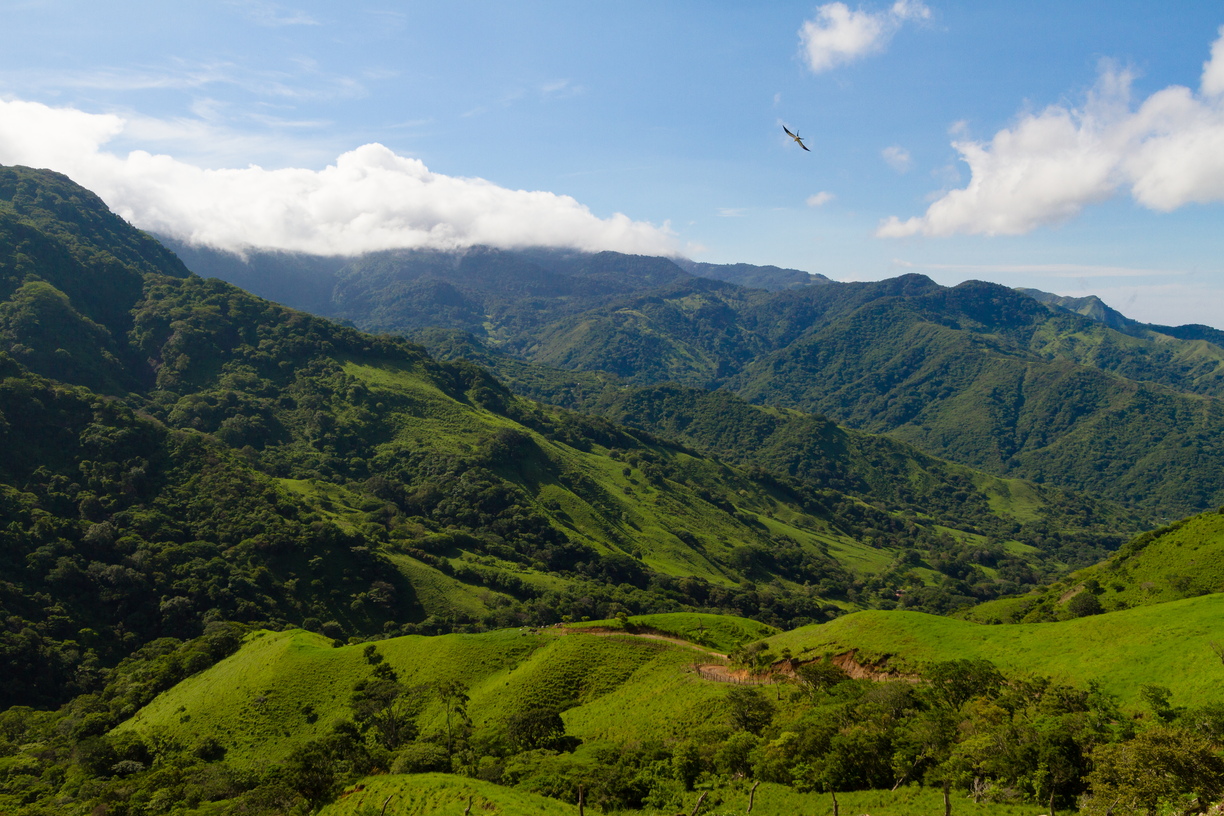
A swallow-tailed kite soars above the landscape of Costa Rica

Driving in Costa Rica is highly recommended (by me, at least!). It’s a fabulous country to explore and having a vehicle gives you the freedom to break free of public transport schedules and tour groups and do what you want, when you want. Other drivers seem quite patient and tend to drive quite slowly, making the experience somewhat enjoyable and, crucially, it’s easy to adapt when picking the car up and taking your first drive. The only exception to this is San Jose at rush hour – we found ourselves going through it three times (we never learn) – and basically you just stand still for a couple of hours and then everything magically clears.  With this in mind, one significant tip to note is that San Jose control freight traffic – they are not allowed in the city centre until 9am so basically:

a) people tend to start work at 8am in San Jose, late-comers strggle in until 8:30.

and…

b) If you can time your trip through the city centre from 8:30am to 8:50am you should ‘sail through’ and miss most of the traffic (we can inform you of this in hindsight having cracked it the 3rd time round!). This is very useful information if you’re driving the airport in the morning.

As we were travelling in the green (wet) season we hired a 4×4 from Vamos. I have never driven a 4×4 and was initially quite nervous of it, but I relished it once I got behind the wheel. I loved driving on gravel tracks, dodging and weaving potholes, drifting around corners and swerving to avoid snakes – it’s a much more exciting experience that I ever get on an inner city ring road!

One thing to expect / prepare for, is that as you increase your elevation, clouds roll in incredibly quickly. If you couple this with hard, driving rain and very windy roads with few markings,  you have yourself a challenging situation – which is nothing to worry about, just proceed carefully and slowly (everyone else will be doing likewise)!

We hired a sat nav (we got it free when ‘liking’ Vamos on facebook) – this was a godsend. Once you are off the main highway there is very little in the way of signage – though, to be fair, there are very little opportunities to turn off – it’s one road and you follow that until the end. However, the roads can quickly disintegrate into nothing more than a gravel trap or forest dirt track, and you will find ourself wondering if you are going the right way. This is when the sat nav comes into its own – it encourages you to carry on when you’re likely to quit and it’s right to do so, especially in the dead of night. Accompanying the sat nav was a book of ‘Eze-codes’ listing all major hotels, attractions and locations. It was  merely a case of locating the code and popping it into the sat nav – and off you went. Eze-peezy! This is what ‘saved us’ when trying to locate our hotel in the dead of night.

On this subject – we were warned not to travel at night, but this is less for security reasons and more for life saving reasons. Due to us mis-timing a trip through San Jose, and then taking 1.5 hour de-tour to find petrol, we found ourselves climbing the hillsides of Costa Rica to get to Santa Clara in the dead of night. This would have been ok if it was not for the people who walk the streets at night with no illumination (you have to swerve to avoid them) – couple this with abandoned dogs wandering the highways, thick clouds rolling in and potholes the depth of mini wells, and you have one heck of a challenging drive. Miraculously we made our way up the windy roads, avoiding plummeting to our death down the mountainside  in thick cloud – but we did not realise just how perilous the journey had been until we did the reverse trip in daylight! It was sobering to say the least.

On this note – many car hire companies do not allow you to take the vehicle to Monteverde because the roads are so bad. Please do ensure that you look for this in the small print before you travel – because it is well worth the journey but your car will suffer – so don’t risk it, as you risk a very hefty excess payment at the end of the trip, instead – choose a provider how allows the car to be taken there.  Please also be aware, it is also not an exaggeration that there are no petrol stations in Monteverde! Whilst some maps might show a petrol station – it is physically still there, but not operational. You therefore need to heed all warnings from car hire companies that you MUST fill up before you get there at the last available station – something we failed to do on account of losing our bearings and thinking we were much closer than we were – the result – we had to ‘watch’ the petrol ferociously during our 4 day stay there and just about got down off the mountain and into a petrol station in time to prevent the car from coughing to death on sand.

That reminds me – tarmac – whilst you have it, adore it! It’s a distant memory as soon as your turn off the Pan American Highway. You don’t necessarily need a 4×4 in terms of off road capability – but we were incredibly relieved that we’d hired one for the clearance it provided us with when bounding over pothole after pothole, swerving around boulders on mountain gravel traps and dodging off-road to avoid wildlife.

Safety wise, we never felt threatened – quite the opposite. Locals would holler and run after the car at the first sign of mechanical trouble to warn us ( we had a spectacular puncture on our trip back from Torteguero). We were, however, warned not to leave anything visible in the car – with a 4×4 with a non concealed boot this proved be a challenge.  When we were in the situation of having to leave luggage in the car – we were relieved that we had huge towels to cover the bags, and we always parked the car in sight of a shop or local tourist attraction that we frequented.

Our car hire was great value for money – we cannot fault it. We grew to love our wee 4×4 (and the colony of ants who lived in it and accompanied us on our every journey). To put you in the picture – when we picked the car up, there were simply too many scratches and dents to report on the inspection report – we knew then what type of a country Costa Rica was an how many adventures we’d have along the way. This pretty much set the scene for our expectations and experiences driving around this amazing country.

Go, explore! Photos from our Costa Rica adventure are now available on-line.

Tortuguero – a cost effective and beautiful way to visit

Tortuguero boat pier

Tortuguero is not overly promoted within Costa Rican travel guides – and for this reason, a lot of people who travel there do so on a fly in package that can cost hundreds of dollars a night …per person!

When reseraching Costa Rica we were enticed by the brief description of Tortuguero presented – that of a natural and unspoilt water world which offers a seducing array of wildlife and fauna. There was the promise of boat trips along the canals to spot wildlife such as sloth, monkeys, snakes, iguanas and jaguars. There was the option of night walks on the beaches to see turtles laying eggs or the eggs hatching (seasonal) and primary rainforest to explore.  I was seduced by the idea of being in such a place where I could connect with nature in a way like never before and I was desperate to find a way to visit without succumbing to spa style hotels and re-mortgaging the house.

The main obstacle for visitors is the fact that there is no road entry, but this only made it more alluring to me. Unfortunately our research repeatedly threw up lots of costly fly in packages at 4/5* hotel complexes which, to me, seemed a little out of kilter with the place itself. Few guide books (if any we came across) even suggested independent travel. We therefore took to online forums, keen to ascertain if and how independent travel would be possible. That’s when we stumbled across the Tortuguero village website – a little gem which offered insight into the local accommodation and offered details of how to get there for independent travellers. One look the price of the boat journey ($7) and the accommodation and guiding on offer at the fabulous Casa Marbella ($55 a night for a superior room facing the river) and we decided it was a no brainer – we could get there under our own steam, stay in an amazingly friendly local B&B, choose our own accommodation and activities  and save hundreds of pounds off the price of  a fly in package! We booked it there and then. It was absolutely the right decision.

We drove to LaPavona (Carairi) from Arenal – a journey we expected to take about 5 hours. We allowed ourselves a window of a few extra hours too, wanting to ensure that we arrived in plenty time to make the 4pm boat. The directions provided on the  Tortuguero village website are a little unorthadox, but incredibly useful but they certainly do the trick … Because you are travelling through the middle of no-where, the directions rely on an accurate vehicle mileometer (ours was not!) and navigation by local stores and handpainted signs along the way.  Navigating in this way, it took us a couple of hours to travel from Guapiles to LaPavova, with the satnat offering little reassurance beyond Cariari.

It is also appropriate to highlight that the directions offered on the village website have not been updated in a wee while – so;

a) when you are asked to reset your mileometer at Cariari petrol station, be aware they now have two petrol stations, one before and one after the bridge – reset your mileometer at the second one.

b) when you are coming back through Cariari on your return journey, be aware that the main street is one way (and not signposted as such!)

c) The first mileage stated is 18 miles – we found it was a few miles less than this. If you hit the crossroads you have gone too far

d) When you arrive at the end of the road (quite literally) there is what looks like a car park and an outbuilding with tourist signange on it for tortuguero. Ignore this and drive past until you can drive no more – then you will see a selection of car ports on your right and this is La Pavona.

e) The rates for car parking (per night) are cheaper in the offseason (I think we paid $5 a night for secure parking). Many of the staff at the farm speak only spanish, but there is one young lady who speaks excellent English (The relevancy of this will become clear in a subsequent post!)

g) Allow yourself plenty time for the journey – the mileage as described on the directions might appear small, but the roads (if one can call them that) are in a terrible state. I cannot for one minute understand why car hire companies ban people from taking their cars to Monteverde but allow them to travel here – there is pothole after pothole. Our 4×4 had significant clearance, but we’d often find one side of the vehicle at a significant angle as we bounced from hole to hole.

h) If you are contemplating this journey, it also helps to know that LaPavona (where you get the boat) is the name of the farm and not a village, so you cannot find it on a satnav by name alone (trust me, I tried!).

We arrived a little battered and bruised from the journey, but extremely excited. We found ourselves in an amazing open sided building from which the most enticing smells of traditional food were wafting. We offloaded our luggage from the vehicle and settled down for a cold beer.

I had all kinds of ideas in my head about what LaPavona would be like, and I laugh to myself now when reflecting on it. I imagined a restaurant on a traditional seaside pier where we’d sip a cup of coffee over a nice meal, watching boats leave and arrive.  In actual fact, the pier is a gentle slope of rubble from a raised grass embankment off a gravel driveway and the only boats that come and go are the timetabled ones – three or so times a day.

The boats depart once the public bus arrives, so shortly after 4pm we opted for the ClicClic boat from Lapavona (Cariari) and piled our (sensible, light and soft sided!) luggage onto an open sided long boat which rocked and rolled as passenger after passenger climbed aboard. Little did I know I was about to embark on one of the best boat trips in the world.

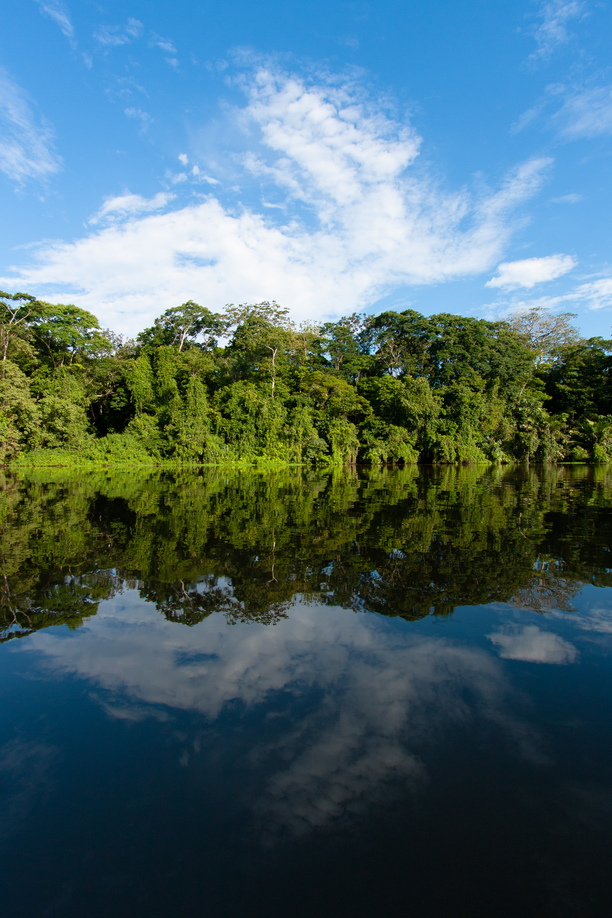
The boat trip took over 1.5 hours and stops as required to pick up and drop off locals at villages on route. The natural canals through which we travelled were narrow and flanked by primary rainforest. We dodged flotsam and jetsom in the waterways, meandered around tight bends and drove through hanging vines.  It is incredibly difficult to describe just how amazingly beautiful the boat trip was. We were travelling through some of the most pristine forest in the world, miles from anywhere, heading to an exotic island filled with diverse wildlife. We scanned the water for otters, caimens and capybaras and were cooled by the spray from the speeding boat. Everywhere we looked tarzan style environments filled our vision. Trees seemed greener and larger than ever before. The water looked silken and undisturbed. I grew very envious of the local villagers living in such a paradise. However one thought kept ringing around my head – why on earth would you fly in and miss this incredible boat trip? Why?! I swear I would go back to Costa Rica if only to take this boat trip. In fact, when it came to the end of our three nights in Tortuguero, I desperately did not want to leave but I was so, so, so excited about the trip back along the canals. I pretty much ran to the pier and grabbed a front seat as soon as the boat arrived and sat there in the baking sun, smile on my face, $7 in hand….waiting.

Soar

Tonight I watched the International Space Station fly above York once again in a perfect arc for around 3 minutes. We all have our individual problems and I know some have many more than others, but we can all look up. Progress – a push into the unknown. Expensive, I know, and sometimes wasteful, but inspiration never came cheap. Inspiration is as expensive as we’d like it to be, given the results should be unlimited. Bring it on, I say – let’s pay for progress, let’s fix these penal micro capital problems, let’s live longer than petty disputes over protocol and standing – let’s be one race and reach for the stars.

That’s how I feel when I watch several solitary astronauts fly around the earth every 90 minutes. We haven’t done anything yet. We have done wonderful, tear-renching things, but we have done nothing yet. Don’t let fear get in our way. Don’t worry about the problems and the failures. The only people who fail are those who’ve never failed; they never tried.

Spotting Sea Turtles

Rainforest is reflected on the silent waters of one of Tortugeuro's many water channels.

We set off at 8pm with Roberto (our guide from Casa Marbella) and two other guests. It was a short, dark walk to the beach front of Tortuguero. From here on it would be a 15 minutes to 2 hour walk before (if!) we spotted anything. We stumbled down the dark beach, banging into logs and debris, tripping over rocks and walking in the surf by the light of the moon and stars overhead. Lightning was striking the horizon, lighting the beach front up temporarily, allowing us to spot turtle tracks in the soft sand leading from the surf to the back of the beach. The sky was alive with a million stars – all seemingly visible with the naked eye. Roberto stopped to highlight turtle tracks, leading lines from the water to the foot of a palm tree – alas, the occupant had been and gone so we continued onwards.

The brief sea breeze offered a moment’s release from the harsh humidity of Costa Rica. I paused to enjoy the moment,  a pleasure that lasted just seconds, because any pause would allow sand flies to start feasting on me. Slapping myself silly I pressed onwards, always scanning the immediate horizon for turtles and tracks.  Every 5 minutes or so we’d stop to do a group count and ensure we had not lost anyone on the way.

Our eyes frantically scanned the shoreline – we were to look out for black spots in the surf. This I found incredibly difficult – not only because my glasses kept steaming up in the humidity, but also because I had no comprehension at all as to how big these spots should be. I’d never seen a wild sea turtle and had not idea what to expect. I knew I’d be looking for either a giant bulk or a minute blob on the horizon, but did not know which and I was therefore next to useless.  I was informed to look for a black spot about 1.5 m long, moving faster than you might expect for a turtle. I tried and tried and tried….

The shoreline was dotted with hundreds of seemingly phosphorescent speckles, which I think were shells reflecting the incredible starlight overhead. If I was not so obsessed with turtle spotting it would have been a very romantic moment. We stopped suddenly – a red light flashed twice in the distance. This signalled to us that another group had found a turtle. More lights flashed and my heart skipped a beat. A shooting star flew overhead and my pulse rate soared – this could be it! We pressed on in the direction of the light, picking up speed and tripping over flotsam and jetsam with alarming regularity. Nothing else seemed to matter but crossing the now shrinking distance between the turtles and ourselves. This could be my first ever wild turtle sighting!

We arrived at the light source some 7 minutes later, battered and bruised. It was a female turtle who had emerged from the sea. A tense 10-15 minutes followed whilst we wondered a) what to do b) what to expect. We were informed that once turtles emerge from the surf they spend about 10-15 minutes combing the area to assess its suitability for nesting. At any point they can turn back and head into the surf at an alarmingly fast rate. It was therefore crucial that we did nothing to disturb her and that we remain at a respectable distance. The suspense was palpable – our untrained eyes could see nothing in the dark, no artificial lights were allowed and we had no idea how close she was and what she was doing. I bounced around like a woman possessed, fighting off the biting sandflies and fanning myself in the incredible humidity.  My fidgety patience was rewarded with good news – she’d started to create a nest! From here on it’d take 20-30 minutes for her to complete the nest and start to lay her eggs.  We therefore settled down and waited, admiring the glorious  night sky. I asked our guide question after question, eager to manage my expectations of what we might see once she started to lay eggs.

Whilst waiting, we jostled with each other for position, crouching, standing on tip toes, doing anything we could to try and make sense of the shadows and catch a glimpse of the nesting turtle. Despite my eyes adjusting somewhat, I still could not make out anything.

After a further 15-20 minutes of waiting we heard a frantic shout from one of the guides – he’d tip -toed back towards the nest to assess her progression and she’d gone. Defying her bulk, she’d picked up speed and was heading back into the surf. We ran over towards the tracks and saw her heading back into the water by moonlight. She was so beautiful. Her bulk was tossed back and forth by the choppy surf as she struggled to migrate from beach to water. Moonlight reflected off her shell and she could be seen for 30 seconds or so before she was consumed by the water and slipped out of sight. That was my first ever wild turtle sighting!

Not to be deterred, we turned and hiked to the next set of flashing red lights towards a Green Sea Turtle who’d been on land and nesting for over 30 minutes. We made it just in time to see her lay her eggs!

4-5 groups had gathered to watch so we formed a single line arching around the horizon of the turtle, everyone eager to have their 5 second views of her laying the eggs. Turtles go into a trance when laying their eggs so she was (thankfully) oblivious to our presence. One by one we inched forward..my heart was racing and my glasses were steaming as I stumbled closer one foot at a time, tears forming in my eyes in anticipation. We were given one beautiful and brief moment with the turtle. Gently holding back her flippers, I saw her lay 3 eggs into the nest, where another 50-60 eggs had already been laid. I shed another silent tear- it was a magical moment.

Walking slowly away I reflected on all the people at home who I know had wanted to see turtles laying their eggs, and vowed there and then to share my experiences with them on my return.

Turtles can lay 130-150 eggs in one night, so we subsequently got a second chance to see her lay more eggs before she woke and started to camouflage the nest with sand, using her flippers as shovels. For a brief moment we got to see her wide eyes as she surveyed the crowd present, so we then stepped back into the distance to allow her to continue in relative peace.

It was then that the volunteers moved in to record and measure the turtle.  It seemed necessary but undignified for the turtle. We watched as her huge flippers flicked batches of sand in the eyes of the volunteers as she frantically tried to camouflage her nest. They worked as quickly as they could but fumbled a lot and the whole scenario seemed somewhat dragged out. It’s then I realised the value of professional conservationists and vowed not to become one of the well-being, (albeit teenage), uninformed and unaware volunteers.  I hoped with all my heart that the turtle would break free soon.

From our vantage point we could see the turtle cover herself and the nest in sand. We stayed for maybe another 10 minutes or so,  but then our 2 hour limit was up and we had to retire from the beach. We started the long walk home with huge smiles on our faces, walking in stunned silence. What a night. So many emotions, so many memories.

You are forbidden from taking photos on the turtle walks, so I am afraid I have no specific turtle photos to share. However, photos from Tortuguero are available in our Costa Rica gallery. 


The benefits of travelling to Costa Rica in the green season

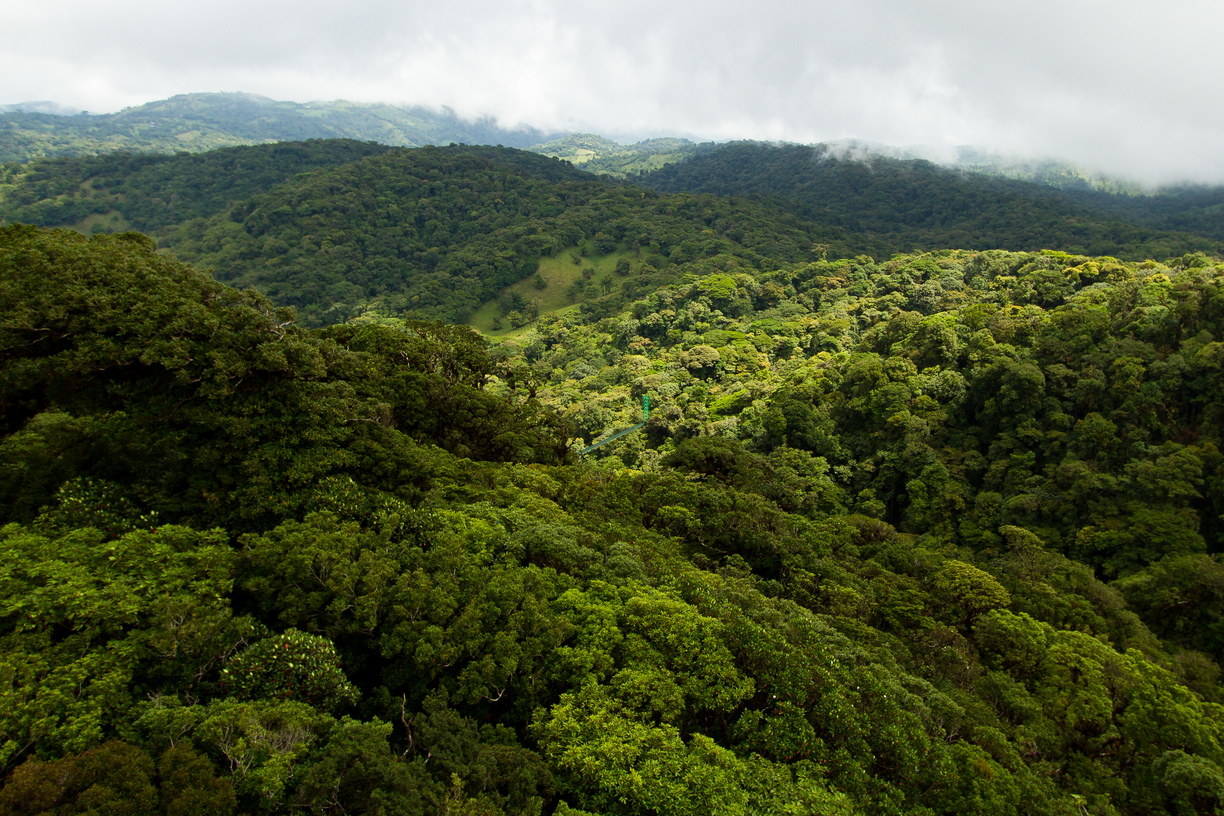
A Vista Above the Clouds

I was initially very reserved about travelling to Costa Rica in the green (i.e rainy) season  – Not that we had a choice, as it came about as a result of a last minute planning.  From my research on the internet and from verbalised experiences of friends of friends I was informed to expect torrential downpours for pretty much our entire visit. I therefore went a little crazy, purchasing new lightweight waterproof coats, trousers, hiking boots and even bought waterproof hiking gaiters. I expected the worst and was, therefore, utterly delighted when it turned out that the green season is one of the best times to travel…here’s why:

  1. Everywhere we went we benefited from much cheaper rates – allowing us to visit and stay at some places that might otherwise been our of our financial limit
  2. Everywhere was much less busy than expected – restaurants, hotels, attractions etc It meant that we had an opportunity to experience Costa Rica as it is meant to be – in quiet contemplation of the forests, allowing the sounds of the rainforest to lull you to sleep, being woken by the sun rising opposed to noisy neighbours. Bliss!
  3. If you are prepared to get up and out early you can ‘miss’ the rain. For example, we often were out and about, hiking in the rainforest by 7am. This allowed a blissful (and cool) 5 or so hours of hiking before the afternoon rains came. This was especially true of Moneteverde Cloud Forest, where an early start meant we were one of the first few into the reserve, and were able to pretty much have the forest to ourselves before the afternoon storms. Once the rains hit, we were pretty much ready for a rest anyway, so we’d head back to our cabin in the forest for lunch during the rains and emerge again mid afternoon once the weather had cleared.
  4. There is a remarkable absence of other tourists. In the Selvatura Park, Santa Elena, we were seemingly the only tourists on the entire canopy tour and on the sky tram. We were allowed to wander freely and as a result, had the huge swing bridge to ourselves. What’s more, the absence of other tourists on the canopy tour meant the bridges were steady and provided a great opportunity to observe the rainforest and take photographs of the rainforest canopy completely undisturbed. On one occasion, we even sat down in the middle of the bridge for refreshment, gently swinging in the breeze and watching the wildlife in the treetops beneath us.
  5. It was quiet – oh so quiet! The overwhelming feeling was one of tranquillity and peace with nature.
  6. Reservations were not required for major attractions. In peak season you’d normally have to book well ahead for sky trams / walks, and for entry or tours into reservations. But the green season meant that we had complete flexibility for our itinerary – we could turn up to whatever, whenever the mood took us and linger for as long as we liked.
  7. Do not underestimate the experience of being in the rainforest in the rain – it’s what it is supposed to be like! What’s more, the rain brings out a plethora of wildlife that you might not normally see. For example, whilst hiking around Monteverde Cloud Forest in the rain, we were delighted and flabbergasted to see crabs darting beneath our feet. You had to watch where you were stepping to ensure you did not crush them. We were also informed that in some rainforests of Costa Rica, there are also turtles in the rainforest!
  8. It’s cooler (Thank goodness!). I cannot imagine what the heat and humidity would be like in the height of the summer!
  9. The afternoon rains often clear the clouds for the evening, providing some amazing star gazing opportunities in the evening. When staying in Arenal, we spent most nights sitting outside under the starts with a cold beer in hand, revelling in the cool breeze and watching the milky way overhead.
  10. Evening storms are often rain free, providing a spectacular lightning display. Whilst staying in Arenal, we  choose our accommodation specifically so we could have an uninterrupted view of the volcano – the lightening storms each evening behind the volcano turned the mountain into a eerie and stunningly beautiful silhouette.
  11. It does not rain half as much as you might expect!
Photos from our trip are available in our Costa Rica photo gallery.

Sky: Challenge, #1

A photograph of the moon in monochrome, highlighting Tycho crater

I’ve set myself a non-committed, loosely monitored, non-binding frequency photography project. Objective is 5 photographs per week, not necessarily posted on the same day they were taken, and the subject will be: Sky.

I just missed the most recent full moon by a day (the Moon Phase Pro app on Android Market is excellent for reminders, but doesn’t help the weather) but this is close enough. This is taken through a telescope pointing at the southern hemisphere of the moon, which I’ve rotated 90 degrees clockwise so that the bottom is pointing to the left.

Unusually, I can’t fit the moon fully into the frame with my telescope – it turns out I bought the wrong one for astrophotography, though it’s great for viewing, and so I can only focus with an SLR when I’ve got a 2x Barlow lens in the eyepiece holder. With crop factor from an APS-C camera I think this means it’s effectively a 2080mm lens, and the vibrations you get from the slightest movement testify to this. This image shows rays of ejecta from the Tycho impact crater are clearly visible on this rotated image of the near full moon taken on 14 August 2011. This is a slight crop of an image taken using a Canon 7D and 650mm reflecting telescope with a 2x Barlow. Shutter speed was 1/30 second though I’ve decreased this by nearly 1 stop.