Home

Day 21 and Inspiration is Proving Difficult

Humble Polystyrene under artificial lights

After a fantastic weekend devoted to learning new macro photography skills and taking some of the best macro shots I have taken to date, it was really hard to come back down to earth and fit in the challenge around the rigour of daily life. Needless to say, I found the challenge tonight quite hard and struggled to find new objects to photograph.

I settled eventually on a sheet of humble polystyrene, enjoying the way it sparkled and glistened under artificial lights and the flash of the camera (above).

I also took the ‘easy route’ and started to photograph house plants, capturing a lovely natural green palette which required no post production colour work (below).

Lets hope tomorrow is an easier ride.

A close up of a green house plant


Exploring a Tiny New World of Insects

A Hover Fly feeds on pollen from a planet stamen

Today (Day 20  of the macro challenge) I spent the afternoon in York Museum Gardens exploring the wonderful word of insects. It was macro heaven! Bees, Wasps, Hover flies, Butterflies, Greenflies,Ladybirds and BlueBottle flies and lots of other insects I had never even noticed before and do not even know what they are! It took me an hour or so to get my confidence to get close to the bees and wasps – but when I did I was rewarded with some decent shots.

Today was my first outside photo shoot for the macro challenge and I relished the opportunity to shoot at a lower ISO. It’s been bliss to come home and not have to do a lot of post production noise reduction on ISO 2000 shots! It’s also been great to have a sunny late afternoon light to shoot in.

Its’ fair to say that I am DELIGHTED with todays’ shots – I know they are a bit stereotypical of macro photography (everyone shoots flies) – but it was a real eye opener to see the incredible detail on these everyday insects and to have the opportunity to glimpse into their world. I especially loved the Hover Flies – after half an hour, two of them became accustomed to my presence and allowed me to get get ever and ever closer to get some cracking shots of them collecting pollen on Lilly Stamens. What’s more -these shots  have had precious little done to them in post production – they have not been succumbed to the usual macro post processing,in fact, two of them I have left as they are with no changes what so ever apart from a tiny crop for composition purposes! That’s when I take the greatest pride in my work – when great shots are natural and require no work.

Two of my favourites are posted here (above and below) and the rest are now available in my online macro gallery . As ever, I welcome your thoughts and feedback.

A fly takes a stroll across a leaf

The effects of mixing your drinks – Day 19 of the macro challenge


Water drops entering water

Today I have spent about 4 hours mixing my drinks! Panic not, I’ve not drunk myself into oblivion over this challenge – I have instead been experimenting with mixing liquids with different viscosity to see the effect it has when pouring them drop by drop into a bowl of water – capturing the shots on camera as I go.

I tried;

  • water with water ( see image above)
  • paint with water
  • milk with water (see image below)
  • ketchup with water.
The best results came from water with water and also milk with water – the results are documented here and within my macro gallery.

It is important for me to highlight that none of these shots have had a lot of post work production done on them – apart from a tiny bit of sharpening / noise reduction and cropping. The colour is exactly as it was when taken. You might, therefore, wonder how I have captured such vibrant and unusual colours…I used blue acrylic paint in the water into which liquids were poured to craete a vivid blue, and I also deployed tactic lighting around the transparent glass bowl to create the best effect. I found that white LED lights shone through the clear glass bowl, illuminating the water from bottom up created the most vivid blue shots. In contrast, a warm light from an up-lighter  angled towards the glass bowl created the molten mercury effects seen in my other shots.

To take the shots I placed the camera on a tripod and located it about 50 cm from the bowl. I took the sun hood off my macro lens and used a remote shutter release to capture the images. I must at this point thank my very patient husband (Ali) for his help – he was responsible for assembling the tripod, manufacturing pipets for me to create the drops, pouring ketchup into the bowl and holding the up-lighter for me. This was definitely a two man job. Without his guidance on shutter speed, ISO and focus range I would still be there now trying to get the shots sharp.

It was the most challenging day yet – I took over 700 shots to get these few – and to be honest, they’re not the shots I was aiming for, but beggars cannot be choosers, and patience is not my best quality. Regardless, I hope you like these…no doubt I will be trying this again in the future to perfect and improve my technique.

Milk pouring into a pool of water

Eating in Istanbul

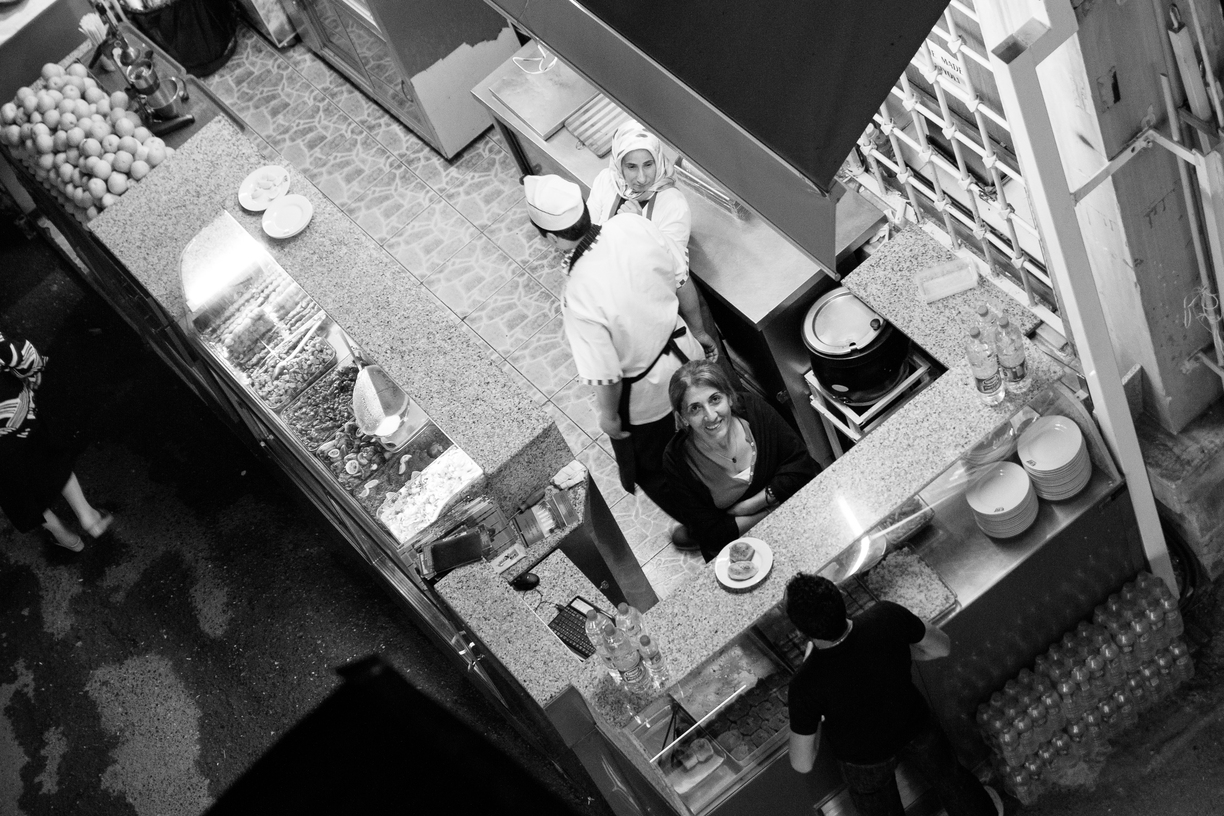
An ariel view of a food stall
The food in Istanbul is simply incredible. I have heard it described as bland, spicy and Asian…in short, it can be anything you fancy, but I would really recommend trying some of the local dishes. We really enjoyed:

a) Pide: imagine a pizza covered in a choice of fresh toppings, freshly made to order…tuna, ham, beef, cheese or vegetables. (This description does not do it justice!) I found it most delicious with an afternoon glass of chilled wine, sheltered in the shade of the various restaurants to the right of  Divan Yolu opposite the Blue Mosque.

b) Mezze; you have never tasted humus until you have had true Turkish humus and Pitta Bread. It bears little resemblance to the stuff we buy from Tesco – its texture, taste and density is truly unique and very well balanced – I defy you not to order seconds! When it comes accompanied by Cacik (tatsiki), stuffed vine leaves and Turkish Feta, all the better!

c) Kebabs – Shish or mixed, you simply have to try them. Put aside all preconceptions of the rotating, processed meat slabs you see on British High Streets and be prepared for succulent and wholesome cuts of steak and roasted meats. The smoked, BBQ flavours are mouth watering and represent great value when served with pittas. We enjoyed several kebabs at the various restaurants of Akbiyik Cd.

d) Vegetarian meals such as Dolma and Moussaka are definitely worth sampling. Rich in spices and bathed in warming sauces, these are a yummy meal in themselves.

e) Whilst we were in Istanbul we witnessed, but never tried, the stews served in the clay pots. Often for two people, the clay pots were brought out on a bed of flames and the clay pot was ceremoniously sliced in front of your very eyes by a long, sharp sword. It’s not one for shrinking violets, as there is often a lot of pomp and ceremony associated with the  slicing of the pot, but the smells that radiated from the stew within were incredible. I wish we’d had the opportunity to sample one.

Photos from Istanbul are available in our online gallery. You might also be interested in our blog about the best place to view the Blue Mosque in Istanbul.

Washing up has never been this fun!

Bubbles in a Honeycomb Formation

Day 18 of my macro challenge and I got very excited when, doing some ’emergency washing up’ –  I realised the potential that Fairy Liquid holds for macro photography. I immediately downed-tools and grabbed my camera. 15 mins later I emerged from the kitchen sink all the happier with some great shots.

What’s great about shooting bubbles is that each time you vary shutter speed, depth of field, light, ISO you get a completely new shot without having to change your composition or location. You just need to bear in mind the bubbles won’t last forecer, so work quickly and shoot frequently.

Both of these pictures (above and below) were taken at ISO 2000, f/9 and at 1/15 sec.

…If you are worried about me, email me at Mariehaslosthermind@worriedaboutyou.com   😉

All the images from my month long macro challenge are stored in the macro online gallery .


An Alien but Wonderful Landscape

A close up of colourful fungi on a twig

Day 17 – and you know when something is becoming an obsession when, on a ‘night off’ you get unbelievably excited by a twig you see by the side of the road. So much so, that you run back to collect it, triumphant that it’s the perfect subject for this evening’s macro challenge.

It’s sad (?) but true!

Documented here tonight are the results of my twig based experimentation. The more I experimented with its rotation, position, colour and expoure, I started to see faces, snakes and other landscapes emerge (I may have lost my mind)….regardless, I thought I would post my results here and see if you too can share in my joy of the landscapes hidden in the world of this twig.

All the images from tonight are stored in the macro online gallery  and below.


A close up of fungi on a twig reveals a colourful but sinister face

A snake emerges from a fungus covered twig

Where best to view the Blue Mosque, Istanbul

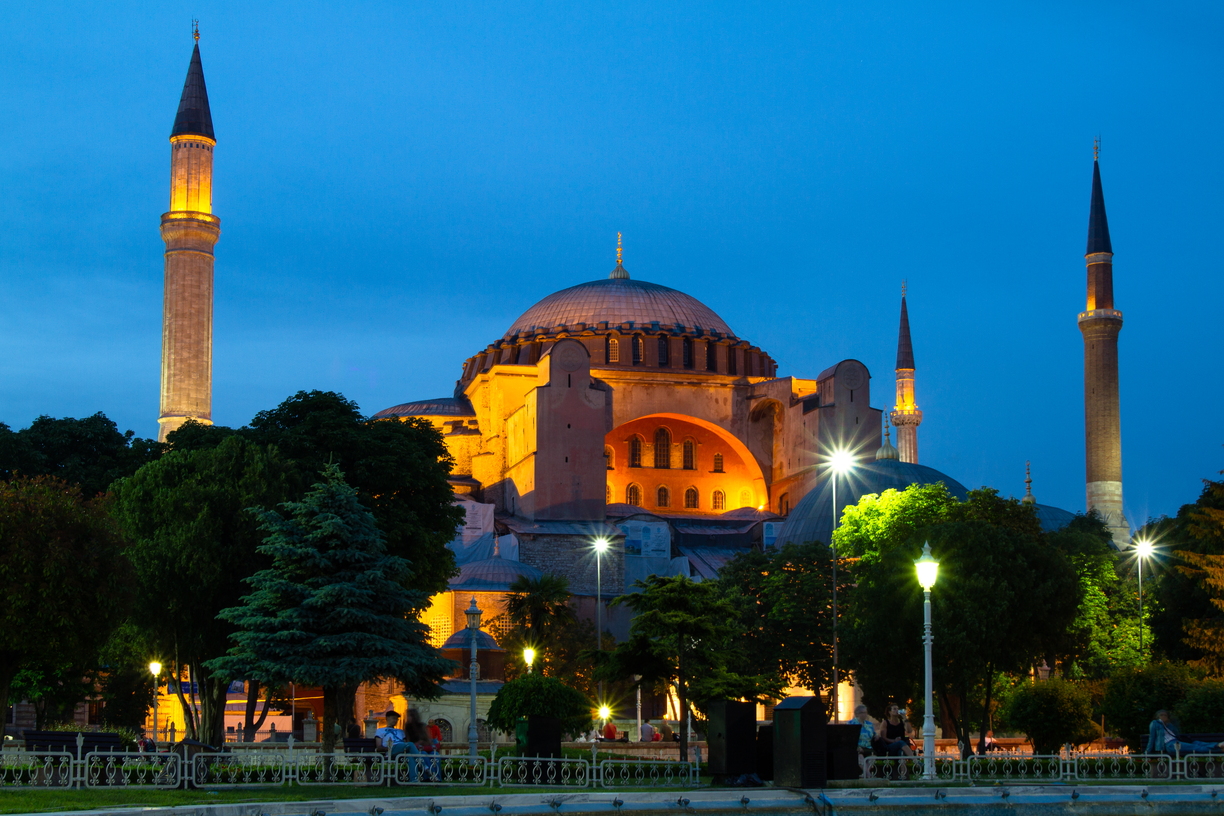
The Blue Mosque At Nightfall
Istanbul is a place that has been on our wish list for many years – the blend of East meets West and the cacophony of smells, colours and sights allured us. Fuelled by our love of Jordan, we urged for an opportunity to engage once more in Arabic culture – ideally without the expense of a long haul flight. So Istanbul it was….the romance of the onion domes across the horizon, the lure of the bustle of the Grand Bazaar and the promise of moonlight bouncing off minarets had us encapsulated as we set off eagerly for our 8th Wedding Anniversary, full of intrigue and a dream  of the Eastern promise.Now, when I say Istanbul did not live up to our expectations I do not want you for a minute to worry about this or draw any conclusion – we merely had a very fixed image in our mind, one that did not live up to reality…call it the ‘guidebook view of a destination’. We imagined old meeting new directly side by side… chopsticks vs kebabs, Asian temples vs mosques, glamour vs rustic……All these do exist – but they are separated by the beautiful Bospherous, so they exist side by side but not in the way guidebooks lead you to believe.What this does create, however, is an amazing city of two halves which co-exist but their undoubted influence never quite permeates each other to the extent expected, leaving you as a tourist free to decide where to roam and what influence to explore. Whilst this can be a slight disappointment upon arrival, it has no longevity – because what you begin to realise is that this city of two halves is perfectly preserving its duality, culture and its heritage…so much so that during our 4 day visit we fell so much in love with the European side that we did not even venture to the Asian side to explore as a tourist! We could not tear ourselves away from the magical mosaics of the Blue Mosque, the warm welcome of the stall holders and the eye watering views from the rooftops of Sultanahmet.  It is probably one of few the holidays that we have truly enjoyed immersing ourselves in the ‘typical tourist scene’

Our most favourite memories stem from the Blue Mosque – from the preserved and quaint rooftops of Sultanahmet. We observed it dawn and dusk, over breakfast and evening drinks. Eiffel Tower aside, it is one of the few building that could reduce me to tears. It’s so simple and elegant in its structure, but so imposing. Its mass is only truly observed from its interior or a distance.  It calls you to scan the skyline for it, no matter where you are in the city. It cries out for observation, for reverence, for appreciation. I’d highly recommend dedicating several occasions during your visit to see it during daylight and nighttime. If you do this you will be rewarded with the views of dazzling onion domes reflecting both sun and moonlight and of the calls to prayer at dawn and dusk – it won’t fail to make your hairs stand on end.

Some of the best vantage points we found for the Blue Mosque are as follows:
1. Standing directly in front of the Blue Mosque (so your back is directly toward Hagia Sophia), walk left in the Blue Mosque gardens until you reach a small stone wall – from here you will have an ariel view of Arasta Bazaar to your left and a stunning view of the blue mosque to your right. I’d recommend you arrive here shortly before dusk with an appetite and watch the light fade over the domes, turning your attention to the ariel view of the local rooftops and restaurant below when your stomach starts to call. If you really want to plan ahead, do as we did and point, wave and engage over the rooftops to the market stalls below…this could be your most unique photo opportunity, or the most original way of making a dinner reservation! What’s more, this view costs nothing.

2. We researched our accommodation well and chose to stay at Best Point Hotel in Sultanhamet, which had a tiny roof terrace looking out over the Bospherous, the Blue Mosque and Hagia Sophia. Its panoramic views might not be open to non residents but there are several other bars and restaurants on Akbiyik Cd and Mimar Mehmet Ağa Caddesi that offer similar views and, off season, you might be lucky enough to have the view all to yourself. For example, we visited Sofa Cafe, which is rustic and requires altitude sickness pills to walk the floors through the hostel to reach the top – but bear with it, order a drink of two (to the waiters’ dismay as they hike back downstairs), and you will be rewarded with not the best service nor drinks ever, but certainly some of the best views of Hagia Sophia and the Blue Mosque, at prices that do not burst the bank.

Other views to capture in Istanbul include;

3. Take a river cruise from the European side of the Bosporus. It takes about 2 hours in total and you’ll be rewarded with views of local mansions, holiday homes, floating bars and restaurants, navy vessels returning to port and stunning countryscapes, in the hillsides of which nestle abandoned fortresses.

4. The views from the city trams…if nothing else, the smugness of avoiding the back to back traffic jams on the roads are a reward in itself. Joking aside, in this lies a very serious learning point – avoid road travel at all cost in European Istanbul and instead elect for the tram or your very own two feet. Traffic jams are common place – it’s not unusual for it to take 2-3 hours to get to the airport by car – a journey that takes less than an hour on the very cost efficient,clean and reliable trams. What’s more – when you delve into Sultanhamet, cars are next to useless as they cannot explore the hidden alleyways and bazaars of old Istanbul and you’ll miss out on so much exploration.

A very reliable (family) source has also informed me that taxi travel in Istanbul is to be avoided – especially from the port for arriving cruise ships. If you elect for a taxi (as they did), expect to travel at many, many miles an hour with a taxi driver who has a confident disregard for the road and it’ll cost far more than you initially bargained for. Instead, grab your zutons (tickets aka plastic tokens) from the sellers by tramstops and hop on and off as you please (you insert your zuton into exit gates on the platform as you disembark).

Don’t let this put you off…go, explore, it’s incredible!
Photos from Istanbul are available in our online gallery.

Something to tickle your fancy?

Day 16 of the month long macro challenge and I am over half way there! So I thought I’d celebrate by showing you a little something that will hopefully tickle your fancy…

I have supplied two images today, both of the same subject matter – feathers.

I had a firm image in my mind of the shot I wanted to capture – ideally a lonesome feather protruding towards the camera, bathed in nice bokeh. For this, I used a variety of artificial light sources and experimented with the camera flash both on and off.  The first image here is taken without the flash and at f/5 – enabling me to blur the background and focus on the single feather. I purposefully chose a less than perfect feather, wanting to create a shot that was not ‘typical’.

Then, using the flash, I was able to take the second shot provided below. At f/5 and 1/40 sec, I captured more of the detail in the feathers themselves and was able to structure a more composed and detailed background. I purposefully centred the image around the curve of a feather, creating a gentle and undulating leading line in the shot. What’s more, the curved feather effectively separates the image in two, and supports a tangible division in the image’s colour balance created by tilting the feathers in the forefront of the shot away from the artificial light source.

I hope you like these!

A close up of a selection of feathers

Driving in Jordan

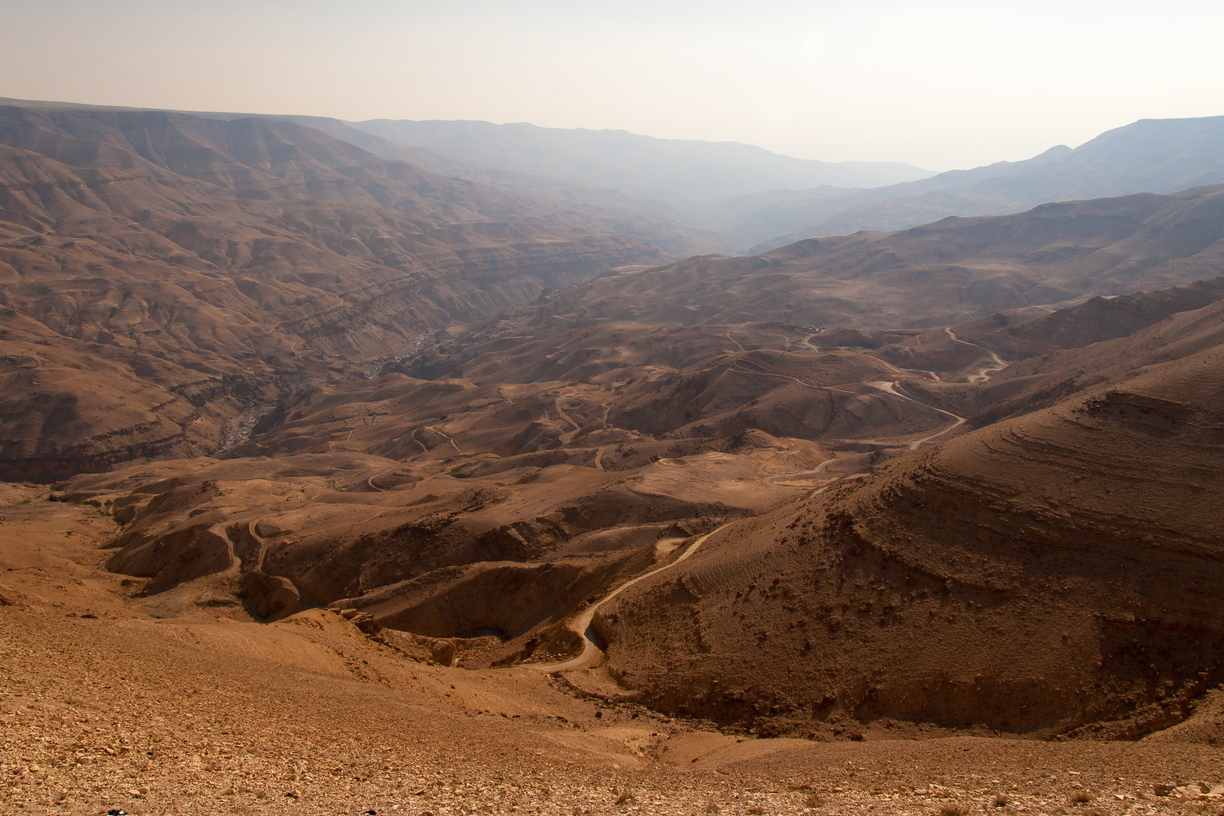
Wadi Mujib, a huge canyon system in Jordan, traced by rivers and road structures.
Driving in Jordan is really not an issue, in fact, it’s very enjoyable. We hired a little economy car to potter around the country in, and had no issues whatsoever.


The main challenge for first time drivers is Amman. If, like us, you have the car delivered to your hotel, you’ll be responsible for getting into, and then out of, the city in one piece. I won’t deny it’s a challenge, but I have one simple tip for you….don’t look back whatever you do!

It is necessary in Jordan (especially on Amman’s city ring roads) to ignore the advice and lessons you were given when learning to drive in the UK. etc We’re often taught to be road aware, and to ensure that you mirror, signal then commit to the manoeuvre. In Jordan – the rule is simple…just manoeuvre and forgot everything else.

Each and every driver looks just one way – that’s forward. By ignoring what’s going on behind and around you, you focus on the vehicles in front and the spaces they are creating and the speed they are going. If you move into the path of another – let them tell you (by a honk and friendly wave) opposed to you worrying about it. It’s simple, and one you get used to it you’ll find it really works if not a tad crazy. You are free of any Western road constraints in the sense that you can move when and where you want, providing there is a space in front of you to move into.

This is really only relevant advice in Amman’s city centre – a complex of ring roads circling the city centre. The most inner ring road is compact, with each concentric ring road widening to cover more and more of the city. Once you’re off the city roads, you’ll find the traffic dissipates significantly and on many occasions you’ll have long stretches of roads to yourselves.

The roads are very well maintained and a 4×4 was not required for any of our travels between;
Amman – Jerash – Petra;
Petra – Wadi Rum;
Wadi-Rum – Dana;
Dana – Wadi Mujib – Madaba – Dead Sea;
Dead Sea- airport.The main road which you’ll inevitably find yourself on is the Desert Highway. A modern and comfortable road stretching pretty much from one end of the country to the other. We travelled it most days to skip from place to place and hardly met any other traffic. Traveling along the Desert Highway you traverse a range of terrain – from the outskirts of towns to wide open desert. Abandoned forts line the desert landscape and small market stall holders are scattered along the sides of the roads selling watermelons fro refreshment. At several points on the trip, the scenery and driving experience reminded me of our American Road trip across Nevada some years previous, it provides the same feeling of openness, exploration and escape.The Desert Highway is not to be confused with the King’s Highway – the older highway which traverses the country at a much more sedate and speed defying manner. The King’s Highway will undoubtedly be much more scenic and cultural, but it’s difficult to travel, and for speed and distance the Desert Highway is perfect for the time starved tourist.

To be honest I have little to say about petrol stations – I do not recall them featuring much on our travels so they must have been abundant and located where needed, as they never became an issue.

To navigate Jordan we used a combination of a Jordan Road map (give to us by our car hire company) and google map directions which we’d printed out in the UK.  We’ve never hired a GPS on our travels yet, and we certainly did not need one in Jordan, mainly because, outside the city of Amman there are very few roads. On the occasion that you’ll take a wrong turn you almost always know the one other road you should have taken as they are few and far between. What’s more, all signs are in Arabic and English and are plentiful, easily highlighting major towns, cities and tourist sights.

It is common to be stopped by Police, especially when you are approaching borders. This is nothing to worry about – just ensure you have your passport to hand (in the car with you) and you’ll be on your way in no time. The officials we met were very professional and very courteous, one, on the way to Petra, even provided directions for us. They’re mainly interested in your documentation, where you’re travelling and staying.  In fact, I had a number of encounters with the Dead Sea patrol when I was driving the car alone up and down the highway to become accustomed to it…Ali was extremely ill at our Dead Sea hotel and I needed to get use to the car before driving us to the airport the next day for our return flight. It was the first time I’d driven the car and I was nervous about venturing out onto the roads alone. It was extremely daunting to have the hotel gates closed and locked behind me – it was just me, miles of tarmac and the Dead Sea patrol point. I did a u-turn around the patrol point at several times after driving up and down the Dead Sea highway and had no choice but to explain to the patrolmen why I was literally driving round and round in circles. They were very amused and sympathetic, and waved madly then applauded every time I approached and circled them and their crossing point. Being so close to the Gaza Strip / Israel border, this was no mean feat for them to be so accommodating and it helped me no end to get accustomed to the car. I felt very safe.

We never drove at night – not for any specific reason, but because we always arrived at our destination before sunset – largely because the Jordanian sunsets area thing to behold and we never wanted to miss an opportunity to witness one. I do imagine that road lighting might be minimal in the evening, and you do run an increased risk of hitting camels or other livestock on the road, which can be both dangerous and costly, so it’s best avoided anyway.

The only ‘dodgy’ driving moment we had was on our through the outskirts of Amman on Easter Sunday. We pulled up at traffic lights behind a tank (yes a tank!). The army personnel decided to have a bit of fun with us and turned the barrel of the gun to face our car. I thought that was us, dead and gone. My heart stopped and ad I not been paralysed with fear I would have screamed. Of course, they meant no harm, but for the look on my face alone I dare say it was worth their while!

Photos from our trip to Jordan are available in our online gallery.

How To Find Wildlife While Trekking

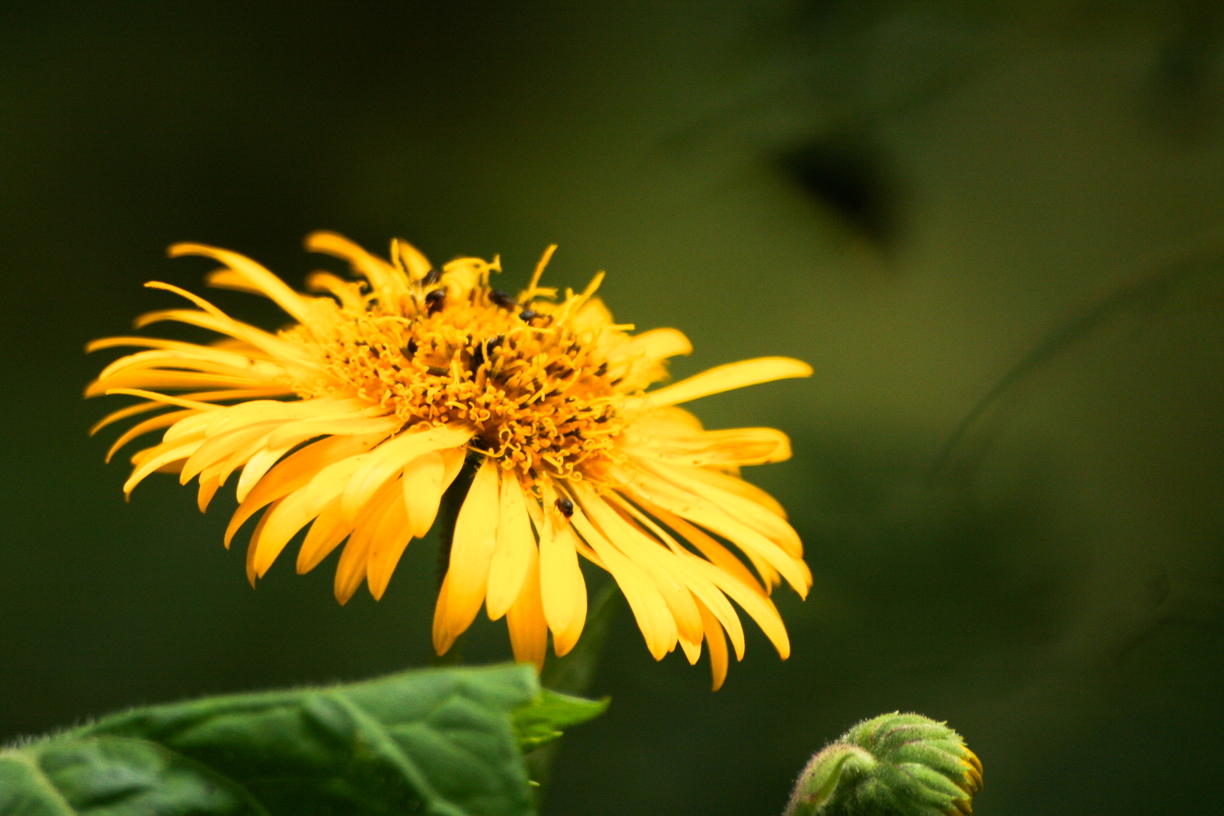
A yellow flower, similar to a dandelion, against a diffuse green background

At the end of June we had a fantastic time in Costa Rica, trekking through cloud and rainforest in Arenal and Monteverde, and kayaking through narrow rivers in Torteguero. While wandering through a trail in Arenal near the volcano, one of us nearly walked into a huge spider, while the other stood back to take a photo of the spider they’d already seen. The former was me, so as a result of that lapse I may not be the best person to explore the nuances of finding photographic opportunities while wandering through jungle, and I’m far from a safari guide or wildlife spotter, but we’ve had some success so we’ll give it a go!

  1. Stop to look around. Whenever you have an inkling that something interesting is around – a faint smell, a repeated bird call, or a frizzly sensation of minor fear – you need to stop and focus all your sense. Not only is walking on while trying to concentrate more difficult than when you’re stationary, it’s more dangerous – when you’re in the jungle you need to keep your peripheral vision trained on ensuring you don’t walk into something unsavoury.
  2. Look up, then down, and always look around. When you’re walking forward through reasonably safe terrain, you can take one long look forward and remember much of the obstacles and where they are – rocks under your right foot in five metres, branches above three metres beyond that. This helps to create a map in your short term memory which provides coarse prompts as you take every few steps – they aren’t explicit, but they say “about this time ago I saw something I should be looking at in more detail now”. It’s important to look up to the branches and leaves here – mainly for spiders and snakes – and also down on the ground – again for spiders and snakes. But with the next 10 metres logged, your main focus will be left and right – primarily for spiders and snakes, and this time because you’re looking for photographic opportunities. In some places you’ll want to look directly above (bat caves; wear a hat) and in fewer locations you’ll want to periodically check behind you. I’d welcome feedback on that but this is mainly where you have known predators who are large and hungry enough to attack humans when you’re out on foot – polar bears are a prime example. With most other species, the only reason they’ll be aggravated is because you disturbed them, and you’ll know about that from your forward glances (unless you’re walking backwards, which is rarely clever, and when it is sensible, you have bigger things to worry about).
  3. Look for distortions. Though a huge number of animals, birds and insects are well camouflaged, with practice and heightened awareness you can pick up on tell-tales. A bigger-than-average welt on a tree branch can turn out to be a curled up snake on closer inspection. A green leaf hanging from a green leaf might look pretty normal, but since when did (most) leaves hang directly from leaves rather than branches? A butterfly!
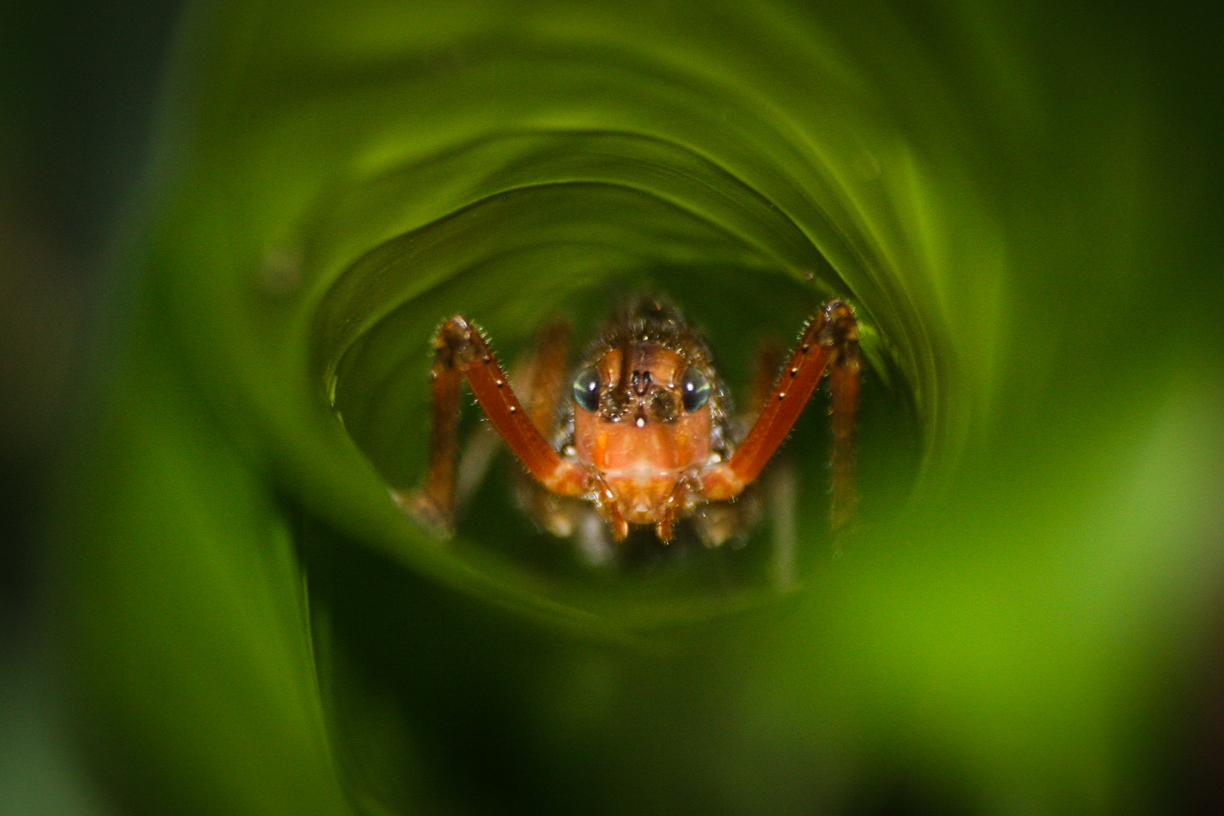
  4. Look for safe places.If you’re under threat, you hide. Many things stay close to hiding places whenever they can – they won’t go out into the open. We’re like that too – we generally feel uncomfortable sleeping out in the open, not because of bugs, but because we’re exposed and visible. Look at the picture of the grasshopper below. I found him in a small fluted, tightly curled leaf in the sparse undergrowth at the edge of primary rainforest in Ecuador. The thing with primary rainforest is that it’s mostly tall trees, with a canopy that blocks out much of the sky and so there isn’t much that grows on the ground. Walking through the rainforest for hours, you can quickly become desensitised and imagine there’s nothing there, but every so often a plant can look too good to be true, and is worth a peer inside – sometimes it’s empty, sometimes it’s hiding a slightly worried but beautiful secret.Grasshopper enclosed by a green curled leaf
  5. Listen. Birds will always see you before you see them. If they don’t like you, they’ll be gone before you hear them make a sound. If they don’t mind you, it’s because they know you can’t see them. Stop, wait for the second and third calls, and try to triangulate. It’s hard in 3D. Then, slowly move around looking for a gap – remember to modify the earlier rule, so first define a circle of a certain diameter you know it’s safe to skulk around in, otherwise you quickly end up falling backwards into uninspected trees. Reptiles that are sunning to accumulate energy will quickly move a short distance when disturbed, but not too far in order to preserve energy. That fast rustle is a give-away. Move quietly and parabolically to try and find them, and as long as you’re careful with your movements, they may stick around.
  6. Think like wildlife. All too often I forget to do this, but it’s the key to understanding how a species operates and where it might be hiding. So, put yourself in the shoes of your sought-after beast, read up a little on its habitat, behaviour and needs, and then when you’re out and about, keep an eye on your surroundings to see if it matches up. With a few notable exceptions, the normal ranges of many species can be quite small, measuring a couple of metres wide. So if you know what lives in shaded, moist areas, look for shaded, moist areas and help your brain out by looking for only those patterns you might expect there (but always watch out for lions!)